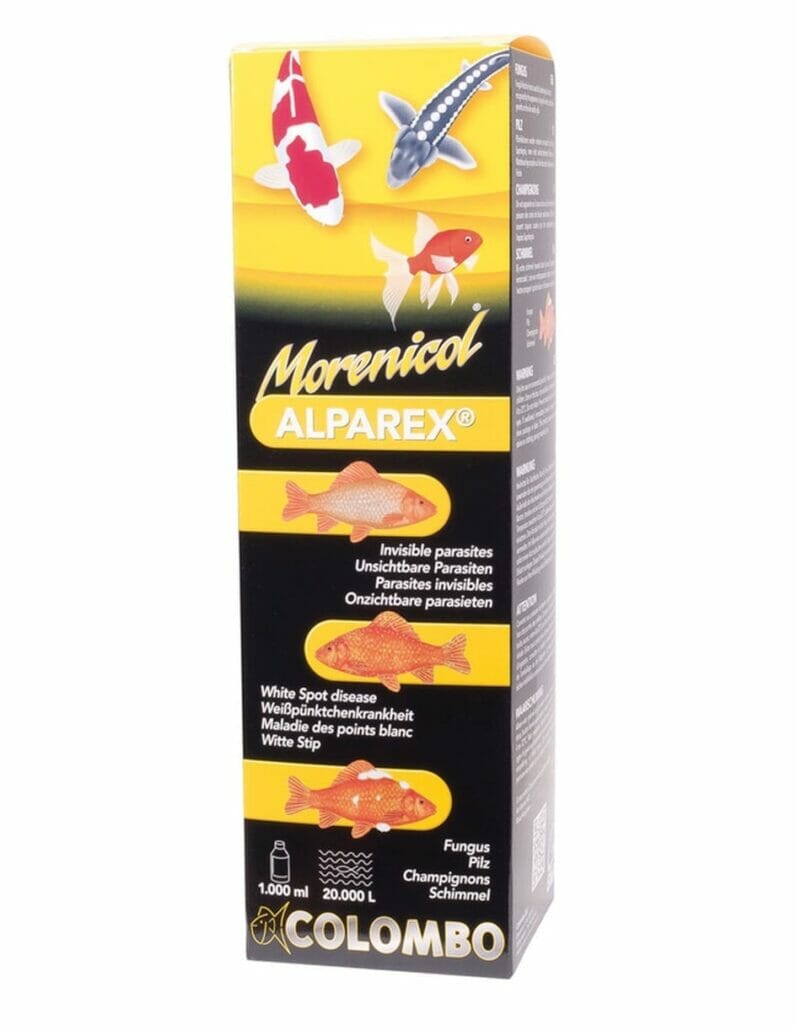
Morenicol Alparex – Effective medicine against Costia, Chilodonella, Trichodina and invisible parasites. Moreover, it is a disinfectant against secondary bacteria infections.
Morenicol Alparex is available in the following sizes: 250 ml for 5,000 litres of pond water, 500 ml for 10,000 litres and 1,000 ml for 20,000 litres.
Water quality: For an optimal effect of the treatment and for a quick recovery of the diseased fish, a good water quality is essential. Hence, always test the water quality before and after the treatment, and correct when necessary.
The KH-value is especially important as this should be between 5 and 6°DH, before the treatment is started.
KH is Carbonate Hardness, this is a very important parameter to observe, please get in touch with us if you are in any doubt as how to check this.
Dosage: Alparex has to be administered in two steps:
1st day: 1 ml per 40 litres of pond water, being 25 ml per 1.000 litres of pond water
2nd day: again 1 ml per 40 litres of pond water, being 25 ml per 1.000 litres of pond water. A measuring cup is included in the box.
Sturgeons may have a reduced tolerance to Alparex in some cases, but their hard skin also makes them less susceptible to the parasites that Alparex treats against. We thus recommend that you do not treat sturgeon together with the other fish, but instead treat them separately with only half the dose (two times 1 ml per 80 litres of pond water instead of the usual two times 1 ml per 40 litres). If needed, a third dose on the third day can be administered.
Measure the necessary amount in the measuring cup and mix with water in a watering can or a bucket. Distribute evenly over the pond. Remove carbon and zeolite during treatment; UV-lamps and ozone should be switched off during 1 week after the last administration.
Combinations: Between the use of Morenicol Alparex and Colombo Algadrex, Lernex or FMC-50, there has to be a waiting period of minimal 2 weeks. Combinations with other products is strictly at your own risk!
Information: White spot is caused by Ichtyophthirius multifiliis. This disease usually occurs when the natural resistance of fish is reduced or compromised. Examples of such circumstances include transportation, overcrowding, water changes or the addition of new fish. Affected fish show white spots on their skin, 0,1 to 1mm in size. These spots can be separate or clustered. The fish chafe their skin on plants or rocks and may sometimes ‘rock’ back and forth in the water. After major loss of (breathing) skin surface or when the gills are affected, shortness of breath sets in and eventually the fish will die.
Fungal Infection (most caused by Saprolegnia) are marked by the appearance of greyish white, cotton-like growths on the skin and/or gills. The fungus grows on the skin surface, but can also penetrate to affect muscles and internal organs. These cases often prove to be fatal.
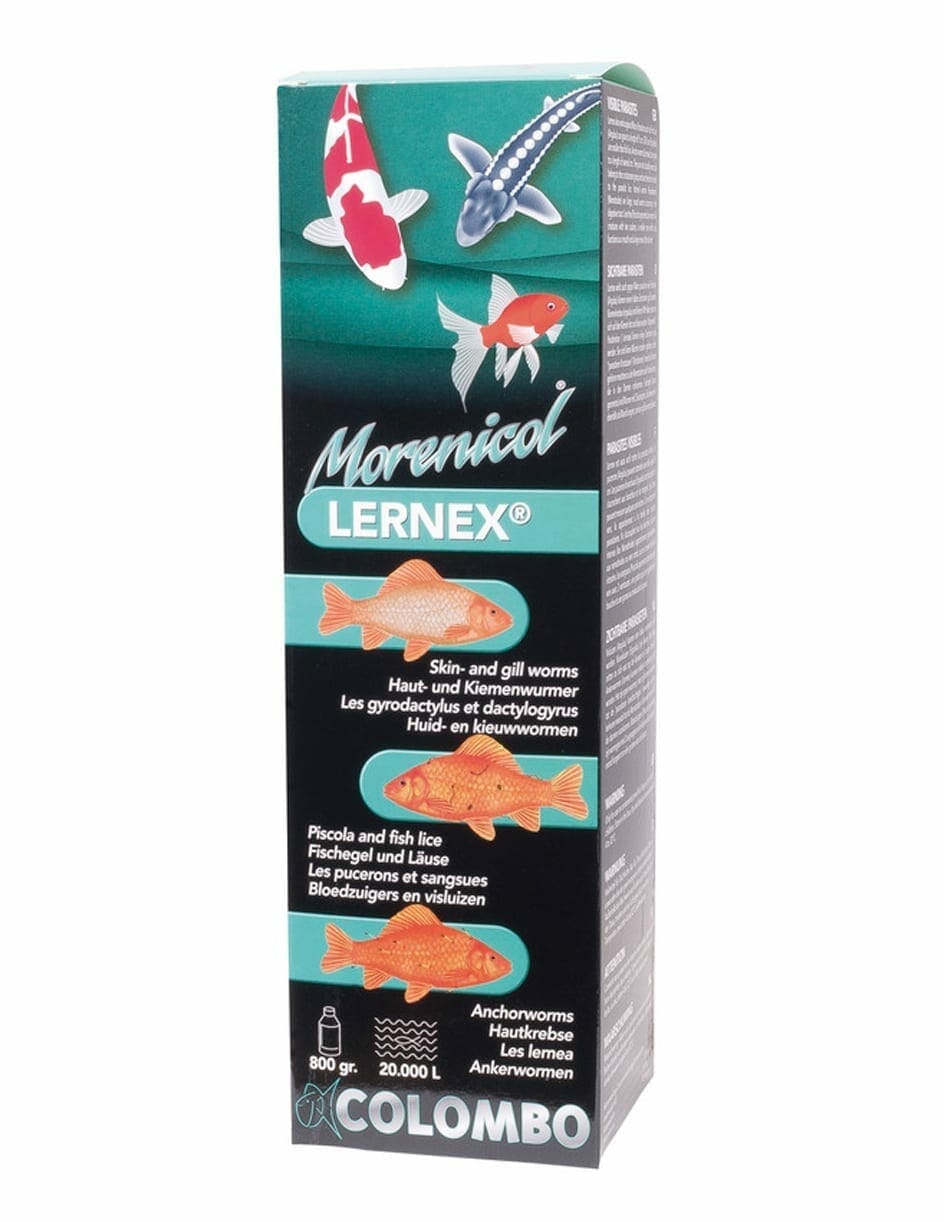
Itching can be caused by several parasites. Examples are: Trichodina, Ichtyobodo and Chilodonella, as do Gyrodactylus (Skin flukes) and Dactylogyrus (gill flukes). These are flat suckerworms, approx. 0,3-0,5 mm in size. The skin of fish serves as the main barrier against pathogens and infection by one parasite can open the way for others. There are often several sorts of parasites present on the skin, and an infection can cause excessive production of slime resulting in a greyish white layer on the surface of the skin. This is easily detected on the eyes, or by looking at the fish from an angle. When the condition deteriorates, red spots appear, the gills swell and breathing becomes faster. Seriously affected fish tend to be listless: they lie on the bottom of the pond or chafe themselves on rocks or plants. Morenicol Alparex contains substances which act against the above named infections. Moreover, it is a disinfectant against secondary bacteria infections. When the itching continues after the treatment with Alparex, it’s recommended to treat the pond again after 14 days with Morenicol Lernex. A specific product against skin and gill flukes, anchor worms, leeches and fish lice.
Only logged in customers who have purchased this product may leave a review.




Reviews
There are no reviews yet.