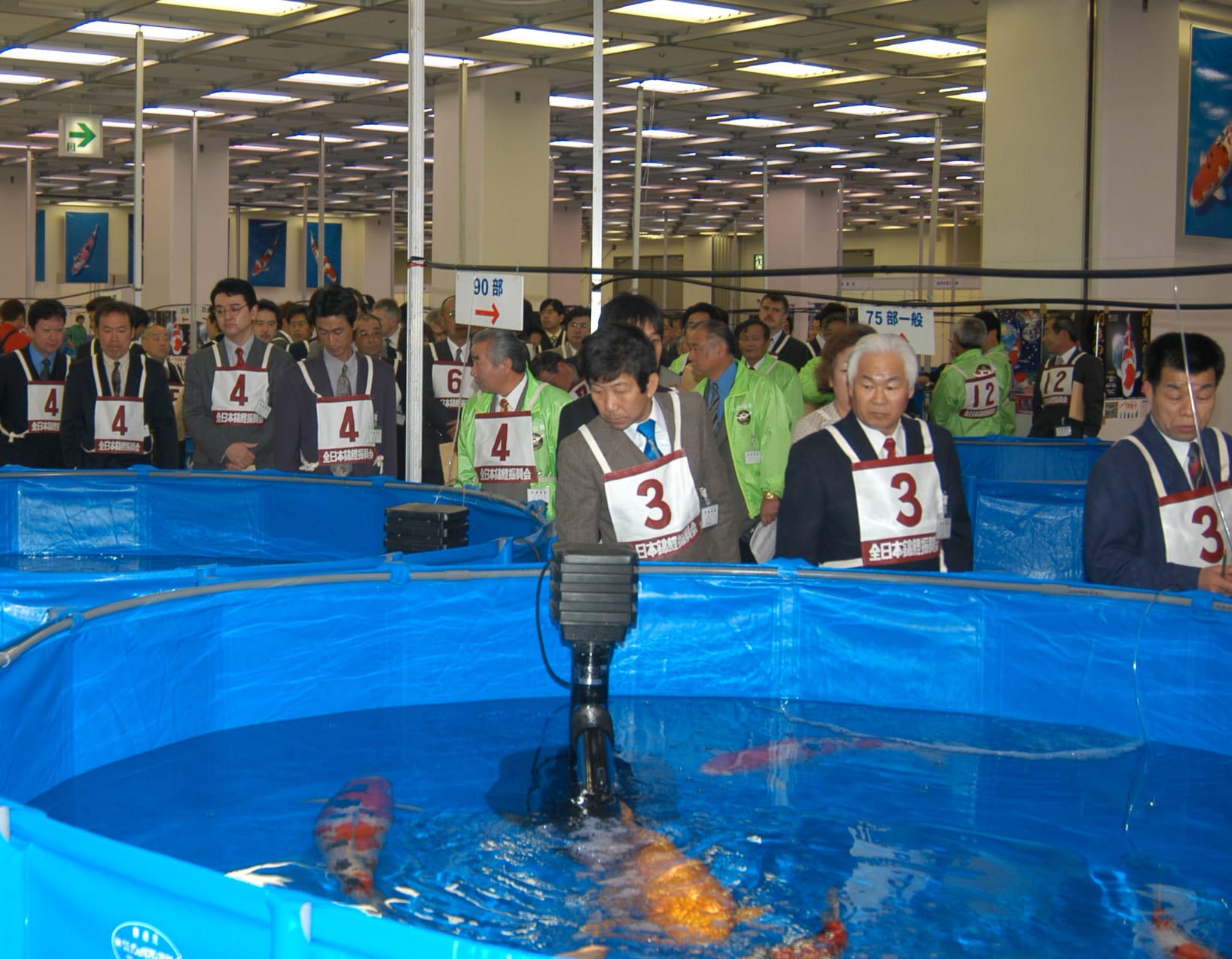
These are the primary assessment criteria applied by UK Koi Judges:
Body Shape
Skin Quality
Pattern
Finnage
Colour
Balance
Deportment
Overall impression
As we’ve already covered the first three on the list in detail previously, in this section well look at the rest.
Finnage
A Koi has 7 fins and all are expected to be present and properly formed. While that might sound obvious its more common than you might think, that its not the case. Judges however are also looking for other additional qualitative elements. The structure of all the fins need to be in proportion, not just with the size of the Koi, but also relative to each other. Over or undersized fins are deemed demerits. The extent to which they’re penalised, depends on the extent of the size anomaly. While this might seem picky, that’s essentially what a judges job is – to be very picky! In practise although finnage is important in itself, its often used as a deciding factor when other elements are close, to separate competing Koi.
With the exception of Motoguro in Showa and Utsuri, and Tejima in the pectoral fins of Sanke (black stripes) all other colour incursion, is deemed a demerit. This renders beni often seen in Go Sanke, or the metallic flecks of various colours often seen in metallic varieties, undesirable. Again these elements are often used as deciders when judges are working to separate competing Koi, of otherwise similar quality. From an enthusiasts point of view its important to pay attention to these factors, for two primary reasons. Abnormally sized fins never get better, just more obvious as the Koi grows, so are to be avoided, but you can only avoid them if you know about the potential issue in the first place, and are paying attention to it! Colour aberration in any finnage is often a clue as to whats going to happen in the future ie: it’s going to get worse!
Clear unstained white dorsal fins are an absolute prerequisite of excellent Kohaku. Its surprising how rare this attribute actually is. Always pay attention to the dorsal fin – Judges do!
Colour
Clearly the sheer diversity of the colour of our Koi is part of their beauty and attraction, but from a Judges point of view, they’re actually much more than that. They are not especially focussed on the conformation and pattern, as the quality of the colour pigment that’s present. Windows, scratches, scrapes and variations in colour are all demerits, and once again although a secondary assessment element, this is also often used as a deciding factor when coming to decisions.
While there are many colour variations it’s the thickness and homogeneity of what’s present on the day, that Judges focus on. They are not remotely interested in potential, or what may or may not happen in the future, all their decisions are based on what’s in front of them on the day!
Balance
This is an important Judging element and it applies not only to all aspects of the five previously mentioned elements, but to the remaining ones also. Without balance even the most striking Koi will appear off. Its often difficult to put your finger on exactly what it is that’s off, but more often than not, it will be a balance issue. Examples are; uneven colours, over imposing or underdeveloped pattern, some minor structural issue, missing barbels, slightly misshapen head, tail or fin, random colour variations or placements, inconsistent with the rest of the colour or pattern presentation. While Judges are trained to forensically examine the Koi and can quickly spot any imbalance anomalies, you can learn this skill too, it just takes time, effort and experience.
Deportment
This is a massively important element and 100% relevant for all Koi at all stages of their development. Deportment refers to the way a Koi swims and carries itself in the water. It should be calm and graceful with the Koi appearing to smoothly glide through the water. Any variation to this often indicates some form of structural issue or anomaly. While sometimes it can be obvious, very often its a result of an internal problem with the Koi, which may or may not have yet presented itself. Typical culprits are tumours and swim bladder abnormalities. Although more common in female Koi, none are exclusive to female Koi. Over or underweight Koi can also display deportment problems, but whatever the cause or presentation, its a big issue when it comes to Judging Koi, and is considered a serious demerit. If its obviously health related, the Koi will also most likely be disqualified by the judges.
When it comes to Koi Health at Shows, there’s zero tolerance for a range of health issues from parasites to physical damages and infection. We’d hope its common sense that the last place any Koi with even a hint of a health problem should be, is at a Koi show, but just in case its not, we’ll mention it here. Just in case you still don’t get it, either the benching team or the Judges do get it, and so will you if you don’t comply, as a dim view is taken of exhibitors who bring sick Koi to Koi shows, either way, they won’t be there long!
Overall Impression
We’ve left the most important element till last, because its not only most important for Koi Judges at Koi shows, but for all Koi Keepers too.
The overall impression offered by a Koi defines it. While the detail contributing factors are also vital, its the sum of those factors, the Koi has as a whole, that ultimately defines it. It’s no coincidence that the Grand or Supreme Champion at all Koi shows is the first decision judges make at any show, and they do it together by consensus.
In formative times the award for GC emerged as Koi progressed through the award ranks, from best in variety and size, to best in size irrespective of variety (Kokugyo) and ultimately from the biggest size champions. The problem with that was that if the wrong Koi ever got through in the early stages, by a wrong decision made by individual judges, which was rare but no unheard of, the collective choice was also from the wrong Koi. This issue was addressed in the 1980’s in the UK, and the new much fairer GC selection process deployed today, ie: all the judges vote for GC as the first order of Judging business emerged, and this remains the case to this day.
Of course for us humble Koi enthusiasts there’s also an important lesson. While its important to have knowledge of the detailed elements of Koi appreciation we have discussed, it’s even more important to understand it, and to never loose sight of the overall big picture. Not only does that define individual Koi, but also our choices and ultimately our collections, and the enjoyment we get from them.