Introduction
Of all the elements of Koi appreciation pattern is the most subjective. Its absolutely the case that one man’s drop dead amazing pattern leaves another stone cold. Its also pattern that bestows one of the most enigmatic features of all Koi – their individuality.
As with most cases in our studies this delivers both good and bad news. The good news is that the degree of subjectivity attached to the entire topic, renders it much less definable, or develop any reliable method to assess it. Ironically, all thats the good news too!
While we can always come up with categories, pigeon holes if you like, for example for stepped pattern we define them as: Nidan, Sandan, Godan etc the real essence of the study of pattern in Koi is to embrace their absolute individuality and simply appreciate them for what they are, individual living works of art. Before you conclude we’ve finally lost the plot, or swallowed some text book or other, we don’t use the term lightly or randomly. By embracing their inherent uniqueness, in favour of trying to define and categorise this fascinating element of our Koi, we can start to better understand the role pattern plays, in the overall picture.
Of course when considering the pattern of any Koi there are some elements that can be deemed requirements and its these we want to focus on in this section.
Completeness
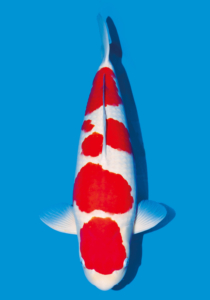
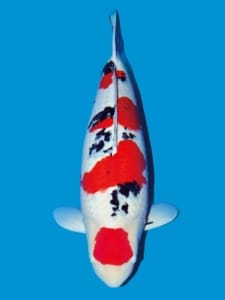
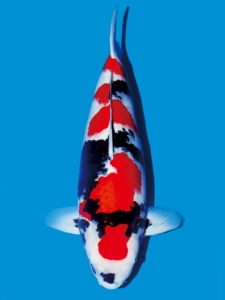
To make a positive contribution to any Koi, pattern must be complete. To demonstrate this point consider how many Showa you have seen with fantastic Inazuma beni pattern, that simply stop at the back of the dorsal fin. Or how many Sanke you might have seen with wonderful sumi patterns on the shoulder, but are then bereft of any sumi at the back of the Koi. Worse, Kohaku with a beguiling pattern that simply disappears half way down the dorsal. Or even worse, continues but starts breaking up as the obviously poor beni simply runs out of steam. Incidentally its these Koi that the less scrupulous breeders transform into Tancho, it’s little wonder some/many of them are in fact nothing more than tategoi Shiro Muji!
The point is any pattern needs to be complete. Half a pattern is like half an engine, half a painted fence, half a decorated wall, not much use to man nor beast. This might be a slight, even harsh exaggeration, but it does illustrate the point.
Add or subtract
Patterns should always contribute to the overall impression offered by a Koi. This might sound an obvious observation, but many a Koi Keeper has been seduced by a fantastic Inazuma Showa, only to have the back end subsequently turn black, and obscuring the back half of the pattern! Or a fantastic Tancho Kujaku with a disappearing Tancho spot. The list is endless, but whatever your personal preference may be, it’s absolutely vital that the pattern is in harmony with the rest of the Koi. No matter how imposing it might be, and while its fine to be the leading act, star of the show, in Koi we seek star quality elements, not on trick pony’s!
This element also applies to Koi that may well have a nice pattern but little else to endear them. Its vital that pattern is one positive element and not, the be all and end all. Pattern should contribute to balance and harmony, not distract or detract from it.
Contribution or Distraction
This applies to Koi with and without patterns! To demonstrate the point we’ll take the example of Koi without patterns for example;Chagoi. While our Chagoi may not have pattern perse, it does have scale reticulation, paying attention to the quality of these elements is important, because it not only helps us better understand Judges decisions for example, but also allows us to make better purchasing decision too. Of course with patterned Koi this whole topic assumes an entirely higher level of importance.
While strong individual elements of pattern often elevate the overall impression Koi offer, they are equally guilty of diverting attention from less endearing elements of a Koi’s pattern. To use our Showa example once again. So many Showa have fantastic patterns running from their noses to back of the dorsal. The problem is the strength of these front end Koi is such that it often completely distract us from the fact that the back end of the Koi is completely bereft of any pattern whatsoever, thus fatally compromising the overall impression delivered by the Koi on more considered reflection, usually after we’ve bought it! Worse still, while that’s always a problem in younger Koi, as the Koi grows and develops so does the imbalance, and while the problem wasn’t so noticeable in our 30cm Tosai – its glaringly obvious now its a 60cms Gosai!
Obscurity
While this element applies mostly to beni it’s not exclusive to it. Sumi can be a double edged sword. Of course great sumi is much desired but you can indeed have too much of a good thing, and some Koi are predisposed to precisely this attribute. While primarily were talking about Showa and Sanke, it’s also relevant to many metallic varieties, and of course Goshiki, Koromo and all Kawarigoi.
While primary beni colour phages are fixed at birth, secondary beni and more importantly sumi is not. So its not uncommon for Showa, for example, to continue to develop new sumi and consolidate initial sumi throughout their lives. In the most aggressive cases this can be an issue. Koi with progressive sumi can start off their formative lives with little sumi, charming shiroji and wonderful beni, only to see it all compromised by the emergence of lots and lots of sumi, that simply obscure everything else.
Even more common is partial progressive sumi, where the Koi develops overwhelming sumi down one side, or the other. While its difficult to spot, it’s not impossible, especially in Showa and Utsuri. Koi with this progressive sumi often have a disparity in presentation of motoguro and/or menware with one side or the other, being much heavily marked. The heavy sumi side often subsequently developing significant progressive sumi, often to the detriment of the overall Koi. While generalising is always problematic, hard water areas have historically demonstrated an increased incidence of precipitating both, progressive sumi and secondary beni. Feeding excess colour food is also associated with an increase in the development of secondary beni. This topic also reminds us of the importance of feeding the right type of food within the correct temperature ranges.
Balance
It’s difficult to over emphasise the importance of balance in Koi. This doesn’t only apply to pattern, although it is especially relevant to it, and we don’t just mean a benign contribution. It’s not enough that the pattern of a Koi doesn’t distract or detract, it must positively contribute and enhance.
While the specifics of the actual pattern might influence our personal choice, it’s the latter that defines it, and makes a Koi judges job, just a tiny bit less difficult. Just like Leonardo’s Golden Ratio determines our overall preferences for form, so the balance, or otherwise, ultimately defines how a pattern is assessed by Koi Judges. Applying this criteria, at the very least, helps us all make better buying decisions.
Control
While some of the elements impacting on pattern we have little influence over, it’s not only important that we leverage those we have, like making good pattern choices in the first place, but even more so, taking control of the elements we do have control over. Specifically that means not overstocking our systems, providing all our Koi the very best water quality we can, and at all times. Effectively managing the environment we keep them in, and that includes managing temperature and core parameters, and by feeding them the right food at the right time.
No one ever said it was easy! The reality of these facts is simply that unless you’re up for the challenge and prepared to invest the time, money and work, it’s not just your Koi’s pattern that might end up compromised, but their lives too. No one whose ever kept Koi will sensibly argue with any of these sentiments. If you find all this interesting and want to learn more….read on.
If, on the other hand you still don’t believe us and think were exaggerating in order to sell you more stuff, then our absolutely very best advice is…find a new hobby!