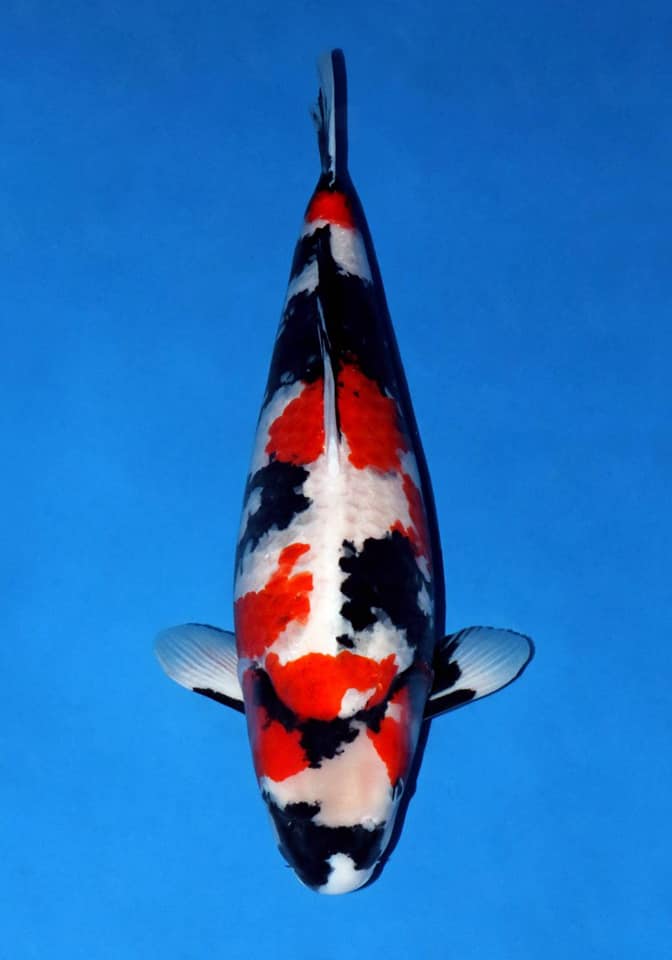
 Of all the attributes Koi require, skin quality is perhaps the least negotiable and most unforgiving. While other aspects, like great pattern, finnage or excellent deportment, provide an additional qualitative dimension, skin quality along with body shape are the two elements of Koi appreciation with least room for quality flexibility.
Interestingly, Koi Judges to this day continue to put body shape at the top of the list, and while there is of course a good argument for that, when buying a Koi its the skin quality that ultimately defines the Koi. That’s not to say of course body shape is less important, its not, but…the reality is, these two elements come as the ultimate quality double act; a defining pair.
It’s also important to note that skin quality in general and great skin quality in particular, comes in a wide variety of guises. High quality skin also varies with variety. While most doitsu Koi appear to have great skin quality, the reality is that the quality illusion presented by not looking at the skin through scales, makes most of them look shiny and bright. The presentation of all the primary Koi colours; beni, shiroji and sumi, also vary with variety. The beni on Showa is different than the beni on Sanke, and when it comes to Kohaku the almost limitless variety of beni types and skin variants render generalised statement virtually irrelevant, and absolutely invalid. So first order of business is, when it comes to skin quality, is to consider each and every Koi on its individual merits. This might sound obvious and even counter intuitive, but when you start to think about it and apply your skills to evaluating specific Koi, it becomes much less so.
Fukurin
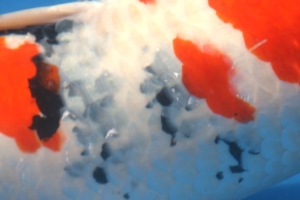
There are some elements that define great skin quality and one of them is the presence of fukurin. Although its not always the case in many cases, 75%+ it is. Fukurin is a skin quality attribute, a skin quality feature, not a scale type as in Gin Rin. This is an important consideration that we discuss in more detail in the Kin Gin Rin Section of our Koi variety section. There’s a photo showing what fukurin actually looks like above, at the head of this section. The sparkling flecks can be sublime and subtle and absolutely not Gin Rin, in fact almost the opposite, although the incidence of confusion is high. The presence, or not, of fukurin is a great first look quality indicator, and being able to identify it is a great Koi appreciation tool, and even better skill to have when considering a potential purchase.
Fukurin is the cuticle of the skin which appears as a line drawn in a ring around a scale. The name was taken from the term Fuku (meaning to “cover” or “wrap”) and Rin (meaning “scale”) a better image to help you understand Fukurin is shown below.

Of course there are exceptions, and many of them, so just because a Koi may not have fukurin doesn’t mean the skin isn’t accomplished, its a positive indicator not a negative one. Similarly its presence doesn’t automatically indicate great skin, so you need to be careful and cautious, and beware about jumping to conclusions. In common with many of the skills we discuss in this information resource, the application, like the acquisition is rarely simple, but that makes it all the more rewarding when you “get it!”.
The late great Igarashi Kazuto perhaps described it best when he observed:
“fukurin is perhaps the ultimate Nishikigoi optional extra”
Shine
While great skin may or may not have fukurin, it always shines and glows! The differentiation is much more subtle and its really about the type and manifestation of the shine. Not so much cotton and silk, perhaps more akin to silk and satin. By first focussing on the actual degree of shine, and then what’s making it shine, if it does, you can simplify and shorten the identification process.
Of course its never as simple as that, and in this case it gets worse because many individual breeders have their own genetic interpretation of high quality skin. For example the famous Mastunosuke shine is bright and in your face, whereas for example the very best Marudo Kohaku have a kind of subtle iridescent glow that emanates from the shiroji and beni, and combine to simply blow your mind!
The very best also get better the more you look at them, and this phenomenon is by no means restricted to our chosen examples of Matsunosuke and Marudo, with literally all the best breeders of Japan having their own individual interpretations, often developed over generation of painstaking selective breeding.
Daylight
Never look at Koi seriously after 4pm…Seriously!! As the wavelength of light shortens and the angle drops below 45˚ Reds and whites take on a translucent glow which makes them look deeper, thicker and ironically – brighter. There has been many a Koi bought in later afternoon in Niigata that when viewed back in the cold light of a UK day, turned excitement to disappointment. This advice applies wherever you are viewing Koi, not just in Japan, from Southend to Sky! – you have been warned!