Japan is an island nation consisting of around 7000 archipelago running broadly 2000 miles North East to South West. Technically the most Northern of these Islands is disputed and Russian administered, the Island of Iturup is less than 10 miles from the coast of Russia, and the most southerly a tiny atoll called Okinotorishima, but to give you more recognisable names Hokkaido in the Northern, and Okinawa in the South.
Over 100 million of Japans total population of 127 million are located on Honshu, the biggest of the islands with Hokkaido in the North, and Kyushu in the South, or technically the west accounting for another 20 million, so 90% of Japans population are concentrated in the cities bigger population conurbations, with many of the outlying regions being sparsely populated. The massive 250 square mile metropolis that is Tokyo is home to around 38 million. Divided into 47 prefectures, these prefectures are similar to our counties or American states. By way of examples we’ll illustrate the geography using some famous breeders;
Breeder City Prefecture Island
Sakai Hiroshima Mihara Hiroshima Honshu
Marudo Yamakoshi Niigata Honshu
Maruyama Isawa Saitama Honshu
Ogata Kurume Fukuoka Kyushu
Japan is located on the pacific rim of fire, the point at which two, the Eurasian and Pacific tectonic plates meet, as a consequence Japan is a highly active volcanic region, and as we know has suffered significant natural disasters from the Chetsu Earthquake that decimated Niigata in 2004, to the tragic Tsunami that followed a 9.0 underwater earthquake, off the east coast of Honshu in March 2011, that tragically took 20,000 lives.
Japan is no stranger to earthquakes or Tsunami, and has some of the most sophisticated protection anywhere in the world, including some of the most advanced Tsunami barriers. Its a stark reminder of whose really in charge of this planet to note that the reason the 2011 tsunami was so deadly, is that her supposedly unbreachable defences were in fact – breached. Perhaps even more alarming is the reason for their breach. The entire east coast of Japan for almost 500 miles along its pacific coast, physically dropped by around 1 metre completely compromising the defences. Equal testament to the power of nature, following the 2011 Sendai earthquake, and over the next three years the coastline was restored to its pre quake height.
Although designated semi tropical its a nation of incredible natural, cultural and physical diversity. From snowy northern Hokkaido, to palm tree atolls, bathing in the balmy south pacific. Vibrant, congested, cutting edge modernity in some of the planets most modern cities, to ancient landscapes where there’s literally no human contact for miles. The diversity of the country is also reflected in her people, but in Japan there’s a twist. While no concession is made to modern life, and technological or commercial advance, these elements exist in a respectful context. Japan manages this conflicting juxtaposition better than anywhere else on earth. It’s not unusual for three generations of a family to live together.
Social, professional and family business is conducted in a structured polite manner, with all due deference naturally offered on the grounds of seniority. In Japan older relatives are respected and looked after within their families, not out of duty – but respect.
The basis for these structures and behaviour can be found in the Japanese peoples fundamental principles of responsibility. They begin with every citizen accepting responsibility for themselves, and all their actions. These principles then extend to their families, their community and ultimately their nation, and all Japanese people embrace and take these responsibilities very seriously. The nexus of these founding principles of society, can be found as far back as the 12th century with the Samurai.
Unsurprisingly, these principles have been often challenged by successive generations and especially in contemporary Japan, but even today although increasingly viewed as “harsh” they’re pretty much in tact. Whether that’s a function of the unavailability of any viable alternative, or the fundamental strength of the values, but this remains a source of debate and contention, especially among younger generations.
Japan is also extremely unequal with differentiation and direct sexual discrimination, remaining even today. There is no equal opportunities act in Japan. It’s also important to understand Japan’s unique racism. Japan really doesn’t care if your white, black, purple, or pink with yellow spots, it discriminates totally, absolutely and without fear or favour. Gaigin is the Japanese term to describe everyone… whose simply, not Japanese. There is also absolutely zero aminos, or malevolence, it’s absolutely simple and unambiguous – Japan simply looks after Japan, and the Japanese after the Japanese, and that’s where it starts and ends. It’s very important to understand and embrace this, when doing business in Japan, including of course, buying Koi!
Obviously this web site is designed to offer you information about Japan and Koi, and Japan is ultimately the destination for Koi aficionados, but the truth is there is so much more to Japan than Koi. Its an incredible country to visit and has a unique diversity of interesting things to do and places to see, that can and will satisfy the most exacting of travel ambitions.
While there are many unique and special elements that make Japan so special, its her people that perhaps most of all make visiting such a treat. The diversity is matched only by the friendliness and respectfulness, and literally wherever you go you will be greeted and welcomed, and in many cases and in the Koi regions in particular, it really is more than the fact that you’re spending money, there’s a shared resonance of purpose, often unlikely friendships begin, even bizarre in their diversity, that can and very often do last the rest of your life.
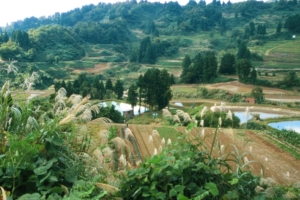
Further, the Koi regions in general and Yamakoshi in particular, have an almost spiritual essence that benevolently lures you in and makes you part of it and it part of you. These bonds are timeless and have no boundaries. In Niigata you’ll often find Koi enthusiasts from five continents, non speaking any of each other languages, simply gazing at a breeders Koi. They may often be silent, but they’re all communicating just fine, united by a common passion and bond – Nishikigoi.
If you think we’re exaggerating we’re really not, its absolutely 100% true, but please don’t take our word for it, visit for yourself and make your own mind up, but be warned. Japan will steal a part of your heart forever, and like many before you, your trip of a lifetime might just turn into a lifetime of trips!


