More about: Visiting Japan – When?
In the headline section we’ve already identified the main “when to visit” option, in this section we’d like to take you on a journey featuring each of the, when to visit options in detail.
In general, time is always the enemy when visiting Japan, but in this case there’s another imperative that although not entirely a deal-breaker, in practical terms is at the very least a determining factor, and that’s distance. The Koi production regions are relatively distant from each other, making visiting them all in one visit, a real challenge. It’s not so much that it can’t be done, of course, it can, but the problem is that the distances involved make it less than comfortable. Our very best advice is not to attempt it. Not because it can’t be done, but simply because the practicalities mean if you do, you’re going to spend an already busy two weeks permanently travelling. As not many Koi keepers visit Japan just so they can say they’ve been, and a visit to experience Japan in general and Koi in Japan in particular, a less manic approach is strongly recommended. This, of course, requires some planning and planning really is often the difference between a trip to Japan, and A TRIP TO JAPAN!
Everyone has their own travel preferences and identifying yours where a trip to Japan is concerned, really is worth the effort and pays big dividends in terms of the overall experience. We’ve already identified the four main Koi regions as: Niigata, Isawa, Hiroshima and Kyushu, North to South or more correctly, East to West, these regions are almost 1000 miles apart. So if you really do want to visit them all, your realistic options are either to visit more than once, or stay longer. This again is entirely personal as while some people have no problem being away for three weeks, others may prefer to split destinations and visit twice. The bottom line is to have enough time to see everything in anything other than a big blur, you need three weeks, or better still two 10 – 14 day trips. In the final analysis, of course, its an individual decision, but if you’re looking for guidance and having done both many times, two 10 day trips would be our choice:
Trip 1 – 10 days total. 7 in Niigata and 2 days visiting Isawa and Tokyo.
Trip 2 – 10 days total. 5 in Hiroshima region, 2/3 days in Kyushu, 3/2 Days in either Kyoto
or Tokyo.
We’ve massively simplified these itineraries and of course, you can mix and match depending on the timing of your visit, but whatever you decide before finalising anything, talk to someone in Koi that you trust, and whose actually been. There is absolutely NO substitute for experience, and when it comes to Japan drawing on it will save you time and money, and lots of it.
Working entirely chronologically, we’ll start with Spring.
Spring Time in Japan
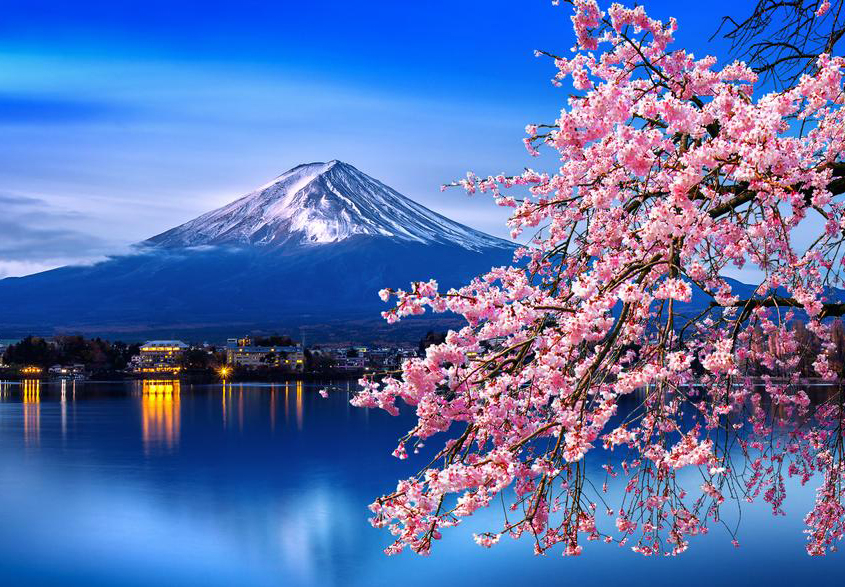
It’s important to say upfront, there is really no single best time to visit Japan. Each of the times we’ll identify for you, have their own special elements unique to them. While Autumn is the iconic harvest time, Spring is Tosai time. While Harvest time sees Japan in her Autumn finery, Spring has Hanami the famous blossom, which really has to be experienced to be believed. The lists go on so we’ve highlighted some of the highlights, in an effort to help you make your own minds up – good luck!
The Koi
Whenever you visit Japan and whichever Koi region floats your particular boat, there’s one thing you can always be assured of, a Koi experience like no other. An experience that will redefine all your Koi aspirations and expectations, an experience that will change your Koi life forever. There is little to prepare you for the onslaught. Whatever you think it’s going to be like, or even hope it might be, the Koi regions of Japan will exceed them all, and blow your mind. If you think we are exaggerating, we’re genuinely not, and to those yet to visit, talk to a few that have, and see what they have to say. While serious Koi hunters can always find Koi in most sizes and varieties, most would agree that Japan in Spring is very much about young Koi in general, and Tosai in particular.
The Weather
There’s a great phrase used by the Scottish tourist board with regard to the weather in Scotland…”if you don’t like the weather, hang around for half an hour”, same applies to the weather in Japan in Spring. One day a meter of snow, the next 20˚C of glorious sunshine, and everything in-between, but whatever its like, it’s never boring. As always its all in the preparation, so make sure you are. A visit to Japan is a bit like running a marathon, and is absolutely full-on! Early mornings, long days and late nights, combined with jet lag to catch out the unwary. Just like a marathon, the best advice we can offer is… pace yourself and stay hydrated. It’s very easy to forget both these especially, when the excitement and adrenalin kicks in, but that can be a very bad idea as many unwary travellers have ended up much worse for wear very quickly. The best advice is much like the rest of our crazy hobby, hope for the best but prepare for the worst.
Hanami
The Hanami or Cherry Blossom season in Japan is truly one of the world’s natural wonders. Its exact timing varies from year to year, but typically starts in late January in Japan’s southern Islands such as Okinawa, making a seasonal progression generally in a north-easterly direction extending throughout the Japanese archipelago, and ending in the most Northerly parts of Japan, Hokkaido, usually in Late May. Hanami is a big deal in Japan and for good reason. The spectacular cherry blossom really has to be experienced to be believed, but the blooming time of cherry trees differs from year to year, depending on the weather, although there’s plenty of information available to help you plan a blossom experience.
The most important factor in determining the blooming time of cherry trees, is the geographical location. Generally, the milder the climate, the earlier the blossoms open. On Japan’s southern, subtropical islands of Okinawa, as mentioned earlier, cherry blossoms can open as early as January, while on the wild northern island of Hokkaido, they bloom as late as May. In most major cities in between, including Tokyo, Kyoto and Osaka, the cherry blossom season typically takes place in early April. The cherry blossom season is also relatively short. Full bloom (mankai) usually occurs within about a week after the opening of the first blossoms (kaika). Another week later, the blooming peak is over and the blossoms are falling from the trees. Strong wind and rain can cut the blooming season even shorter. Every year, weather services and the media, including japan-guide.com, closely follow the so-called “cherry blossom front” as it slowly moves northward. For this reason, a representative sample tree is selected to define the date of kaika (the opening of the first blossoms) for a whole city. In Tokyo for example, the sample tree is located at the famous Yasukuni Shrine.
Although timings can vary significantly from year to year, cherry blossom trees are sensitively and extensively planted throughout Japan, and are a genuine natural wonder that captivates all that experience of this unique phenomenon. Even for the most dedicated and focussed Koi enthusiasts, experiencing one of the natural worlds true wonders is a highly recommended experience for all springtime visitors to Japan, if you can.
Magic Meltwater
One of the most misunderstood elements of the Japanese Koi industry, is the not so humble mud pond. There are lots of widely held misconceptions, and understanding “them” and the important role they play in the overall Koi industry, is both interesting and important.
The first misconception is that they are “natural”, the reality is there is nothing natural about a Japanese breeder’s mud pond. They are totally man-made and operate only for a specific purpose, within a relatively short timeframe.
They contain little or no natural food, and are systematically decommissioned at the end of each growing year, and then painstakingly and meticulously prepared, and recommissioned for use at the beginning of the next. The lack of natural food in mud ponds means the Koi have to be fed daily. Feeding the precious contents is a definitive double-edged sword. The work involved is significant, daily visits to mud ponds to feed the Koi, that are often in individual ponds, often spread over a wide physical distance, and of course the larger the breeder, the more ponds and hence more work.
Technology is also of limited help, even with the deployment of solar-powered feeders which are now increasingly used. These units, like all mechanical devices, however, are, by definition, not 100% reliable, so most breeders still like to physically visit all their ponds on a daily basis. These visits also help to reduce or at least deter predation, as even today most pond predators prefer privacy! But the real benefit of these daily visits is the opportunity to simply look at the developing Koi, and continually gauge improvements – or not! Breeders are continually evaluating their Koi. Culling Koi is a mental as well as physical activity, and is genuinely an ongoing process, literally from the day the Koi are born to the point when, at least with some degree of certainty, the breeder can form an opinion about the crucial “keep and grow, or sell” conundrum that he’s been wrestling with not just for months, but from the day each Koi was born! This might, on the face of it, sound a bit of an exaggeration, but as you will read later – it’s absolutely not. Consider also the breeder will be doing this for literally every single Koi he’s growing. If you have any doubt as to the validity of this assertion, consider the upside and downside of any mistakes or misjudgements in this regard. As you will read shortly, we have a clear view, as to the actual percentages that apply to most professional Koi breeders?
In addition to having the unique potential to deliver genetics, defying growth and development, benefits that positively transform Koi, mud ponds are also potentially very hostile environments, being seriously vulnerable to flooding, landslide, drought, oxygen deprivation, contamination, water quality deterioration, and perhaps most serious, they are a veritable predator’s smorgasbords! Anyone of these variables, is absolutely capable of inflicting losses of up to and including 100% of the mud pond contents!
We mention this because when a breeder offers you an “exciting opportunity” to leave your Koi to grow for a season in a mud pond, the risks are often mentioned less than the potential upside. Having experienced both sides of this especially sharp double-edged sword, we are here to tell you that while the potential benefits are indeed real and exciting, so too are the risks which are equally clear and present, only in this one you end up paying for the privilege whatever the outcome. In the final analysis of course whether to grow your Koi for a season in a mud pond is an individual decision, but to make a good one you need all the facts and information, not just the pros.
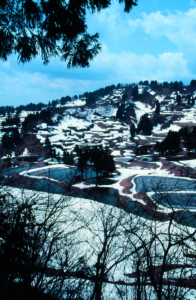
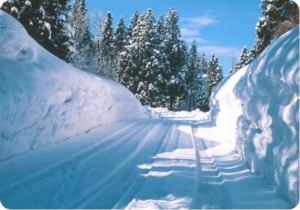
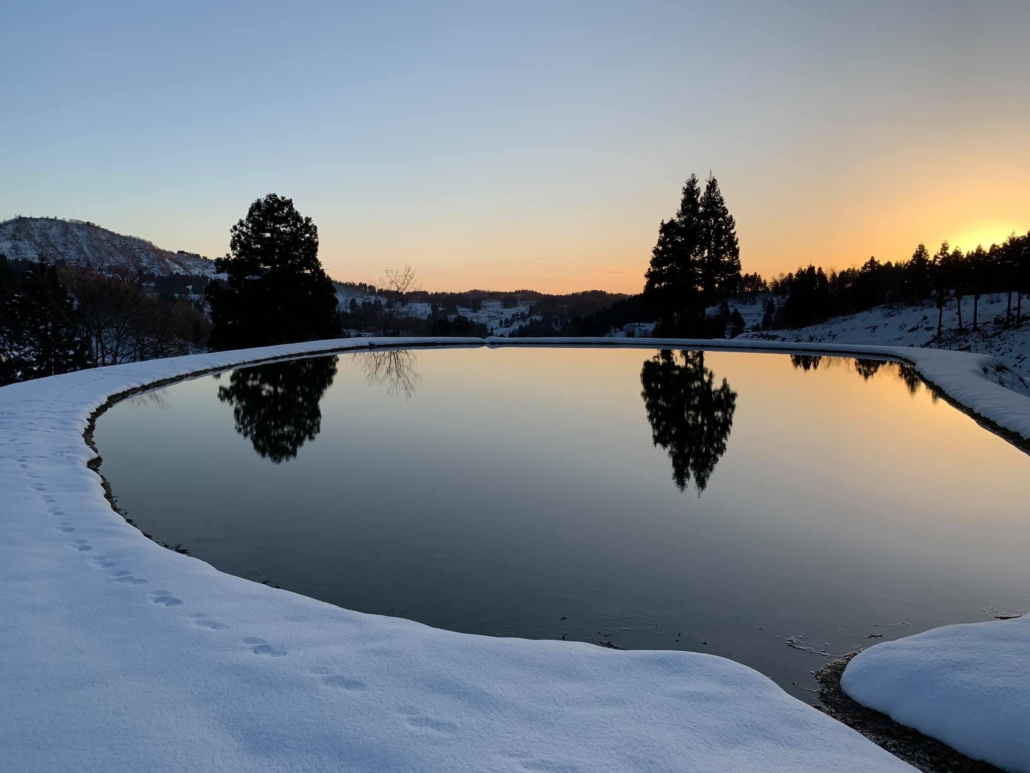
The vital role of mud ponds we mentioned earlier also have is that in all their many and varied incarnations, they are essentially meltwater reservoirs. In the winter, in Yamakoshi especially, they experience almost biblical inundations of snow. 1m falls overnight are far from unusual, and 5m snowdrifts can often be seen in the mountains. All this eventually melts and when combined with the regions unique geology, provides the ultimate growing environment for Koi – mineral-rich clay with the purist mountain meltwater, that percolates from the high mountain catchments, into the lowest. This magical combination has been delivering the goods for generations!
The 100 Day Sleep
The above inundations of snow effectively negate much meaningful endeavour by the breeders, often from early December through to the following March, when nature finally begins to release its icy grip, and things slowly begin to revert to some degree of normality. This is a period of battery charging, reflection and planning, is wistfully know as the 100 day sleep. Even in modern Japan, with all its technology, ingenuity and simple hard work of these stoic and resourceful people, the mountains of Yamakoshi in winter, really are not for the faint-hearted.
Koi # 51
Selecting and deciding which Koi to keep to grow for another season, is the ultimate Koi breeders art. There is no science involved, it’s simply a unique combination of skill and experience, and the individual “eye” of the breeder. The selection process starts before the Koi are harvested, and is daily. While it intensifies following the Autumn harvest when the breeders get their first close look at their Koi, the selection process is just that – a process.
The challenge is however that there are few of the many processes that constantly occur in the precarious lives of Koi breeders, more important than this one. Consider for a moment the consequences of failures or errors? Disastrous, really is no exaggeration. “missing” a potential future Oyagoi (parent), Tategoi, or valuable sale Koi in the ongoing selection process, is simply not an option. The consequence of this reality of Japanese Koi life, is that the failure rate for surviving or successful Japanese Koi breeders – is zero, it has to be!
Further in this regard, we want to burst one specific bubble of Koi hunters who visit Japan, to spot “the one that got away or missed”. The reality is there are NONE! The reason is very simple, any breeder who does fail in this key regard isn’t going to be in business for long. While that might be a little demotivating for some, we do have an alternative, and this alternative is absolutely real, and it’s an alternative that if you’re in the right place at the right time, offers real excitement and potential, to really to pick up the Koi of your dreams, at an affordable price. We call it Koi # 51 syndrome.
Most Koi breeders are also massive Koi enthusiasts. To do what they do they have to love Koi, and have embarked on what is more of a lifestyle vocation, rather than primarily just a job or even a business. That actually makes the selection process more complicated, because by virtue of the skill levels and experience they possess, breeders minds are filled with even more “whats if’s” and “if this does that or that does this” than normal Koi enthusiasts or even professional Koi dealers.
That goes some way to explain why the selection process is so tortuous and takes so long, especially in a good year. But consider this: All breeders have the same basic problem – they can’t keep and grow everything. That prerequisite necessitates some very tough decisions have to be made. Of course, the difficulty and complexity vary wildly from one production year to the next, and is especially difficult in good years when the quality is high, it’s nevertheless a big challenge and arguably even more important in the less good years, when there are fewer high-quality Koi to select. This years’ “keeper” might well be next years “reject” and of course, vice versa.
So let’s take a specific example of an individual breeder. Our breeder harvests all his Tosai mud ponds and out of an original highly culled selection of 5000, the 500 he just harvested from his grow for a season Koi, now has to be gotten down to the final 50, so he has space to grow in his mud ponds next summer. This logistic fact of life throws up another fascinating reality. All the running costs for his entire Koi farm plus all the living cost of his often extended family, have to be covered from the sale of these 450 Koi!
This impossible decision of which 50 of the 500, is of course relentlessly and tortuously procrastinated over. In the old days when indoor facilities were rare or non-existent, there was much less time and decisions simply had to be made, but today with the massive proliferation of indoor facilities, the breeders have the albeit very expensive option of hanging onto the Tosai for a few more months, and continuing to grow and develop them in their indoor facilities. Theoretically at least the more the Koi grow and develop, the less difficult the selection process, but we all know about theories! Of course the sheer volume and enforced relatively high stocking rates, has an impact of the outcome, but it does buy the breeder more time to peruse and ponder over his precious crop. Its all a massive balancing act, but indeed one worthy of any Cirque du Soleil listing.
By late March, early April, however, the crucial selection process has to come to a conclusion. Although it seems to get earlier every year, the momentous final decision has to be made, which of the minuscule number of 10% of the very best 500 expensively overwintered Koi, from the farm’s original total production of perhaps 500,000 Tosai the previous year, are good enough to be grown for another season! Of course, while that’s a seriously tough and momentous call for the breeder, its also the essence of a massive opportunity, for serious and informed Koi hunters.
Consider the definitive difference between the 50 Tosai that are kept by the breeder, and the other 450 that, entirely due to logistics and the limited availability of mud pond space, the breeder now has to sell? More so, consider the real difference between Tosai # 50 that’s kept to grow for another season, and for example Koi # 51 that’s now available for sale! Or for that matter Koi number 52,53,54, 99? or even #449 for that matter?
The key to having access, or not, to these Koi, is 100% down to your dealer, and his professional and personal relationship with specific breeders. All breeders endure and Koi dealers know of this process, and obviously priority access is afforded by the breeders to their most important, respected, favourite, valued customers and usually, that means Koi dealers, wholesalers and agents. But… If you are lucky enough to visit with the right dealer, to the right breeder at the right time… the potential for the purchase of your life, is absolutely possible.
The breeder’s final selection process also only considers his experience, and his perceived view as to what his customers might ultimately want in a Koi. Of course, by definition, that’s not common to everyone, so the opportunity to access Koi with absolutely the necessary qualities, but with say pattern variants that may or may not appeal to specific customers, in our view actually adds an extra degree of excitement and opportunity to the overall possibilities?
The final fact and reality we’d invite you to consider, is that the acquisition of these Koi # 51 Koi, is that these very real Koi actually represent a much more realistic possibility, than for example chasing the mythical ones that got away or slipped through the selection process net, which really don’t exist… whereas our Koi #51 syndrome Koi – absolutely do!
It’s also important to note that Spring is not just about Tosai. These days you can find Koi of pretty much any size and variety available most of the year. While there remain seasonal emphasis, Koi are much more available than they ever were. The Koi industry in Japan has come of age, grown-up and fully engaged with its international markets, and as such is genuinely more accessible than its ever been.
Winter!
Wintertime might not seem an obvious time to visit Japan, and it’s not apart from those three magic little words…The All Japan.
At the end of January, beginning of February every year there is staged a Koi show like no other on earth. The All Japan. Or, to give it its correct title the Shinkokai All Japan. Confused? We’ll explain. Japan actually has two All Japan Koi shows. The first is organised by the hobbyists’ organisation the ZNA (Zen Nippon Arinkai) this show is hosted by a different chapter of the ZNA each year, hence it moves around Japan. The second is organised by the breeders, dealers and Koi professionals organisation – the Shinkokai, and that’s held at the same venue every year, The Ryutsu Centre in Tokyo. It’s this Show, the dealers show, Shinkokai, that’s most famous and has developed into the worlds number 1 Koi show, and is the show everyone wants to win, and everyone wants to visit! And its this event that’s become famous the world over, and is referred to as The All Japan.
The reason it’s so important and prestigious, is that its the Koi professionals showcase event, their shop window where they show off their very best Koi. Even today there is no cash involved, Koi and their breeders and owners compete simply for the prestige, and what prestige!
Even in post KHV times, more than 2000 of the best Koi on the planet compete for Japan, and the worlds most hotly contested awards. There is absolutely nowhere else you can expect to see Koi of such quality, all in one place at one time, and at the very peak of condition and quality. It’s a sight to behold and everyone interested in Koi really should try and visit the All Japan, at least once. It’s truly incredible!
Its also really the reason there’s a third when to visit option. Because its held in Tokyo and all Japans transport links start or end in Tokyo, its easy to visit anywhere in Japan from Tokyo. Whether its a 120-minute shinkansen ride North East to Niigata, a 90-minute ride to Isawa or a 500 mile Nozomi (fast Shinkansen) ride west to Mihara, and the amazing breeders of Hiroshima, or indeed Kyushu, another couple of hours drive further west, its all relatively painless whatever your choice.
However, the old boy scout adage of being prepared, applies absolutely if you venture to Japan in the winter. Although Japan has hot summers, depending on where you visit, it also has extreme winters. In Niigata 3 metre overnight snowfalls are not uncommon, and 1-metre inundations are the winter norm, most years. Despite these almost biblical snows, a combination of modern tech and Japanese ingenuity, ensures that although conditions can be extreme, travel is possible most of the time. While in the UK leaves on the tracks cause chaos, in Japan metres of snow are simply dealt with, and disruption to the almost military JR (Japanese Railways) timetable is very rare, and cancellations almost unheard of!

But if you do venture to Japan in the winter you’re going to need appropriate clothing, and to experience some snow! In Japan, it’s simply a seasonal occupational hazard, but visitors are often amazed at the sheer extremity of the snow. As a total aside, if you’re a skier, have a go in Japan, there are some amazing Ski slopes and Echigo Uzawa, the stop before Nagaoka, Niigata is an internationally renowned ski resort, with amazing runs and facilities.
We know few Koi visitors to Japan who not only endorse it to fellow travellers unequivocally, but that also find a small part of themselves forever mentally journeying back there from time to time, either consciously or subconsciously such is the unique mystique of this territory. For the truly afflicted The All Japan often leaves an indelible mark, and has certainly stolen a part of the heart of many a big ugly ordinary Koi bloke, who are drawn back to return, time and time again for no other good reason than the fact that they can… So if you can – do it!
While the pace may be less hectic in Winter, there are still lots of Koi for sale. While it’s true there are not as many available as in Autumn or in Spring, the long Japanese winters mean that selling Koi in Winter, and realising some income in these quieter months, can be welcomed by many breeders, and in 2020 and beyond the seasons are much more blurred than in the past, and the proliferation of greenhouses and bigger and better indoor facilities, have made the whole visiting in winter experience, much more viable.
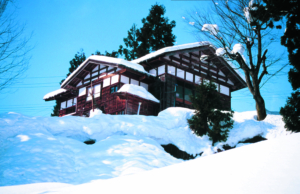
The snowscapes of Japan in general, and Yamakoshi in particular, can be spectacular and some of the mountain scenes you may be lucky enough to encounter, provide an appropriate context for the incredible Koi you might see also. Japan has incredible natural beauty, matched perhaps only by its diversity, and winter has its own particular majesty that really is like nowhere else on earth.
One final word of caution we’ve mentioned already, that its always a good idea to make an appointment to visit a breeder, this is especially the case in quieter times generally, and winter in particular. This is also critical around the time of the All Japan Show, when breeders often allocate their time exclusively to preparing, transporting, visiting, and returning their Koi from the show, so may just not be available for a visit, so don’t leave it to chance – make an appointment!
Autumn
Time to get off the “when and where” to visit Japan fence!
While there are various perfectly viable options pertaining to both primary questions; when and where, the truth is there is one very simple answer to both. For serious Koi enthusiasts, there is literally nowhere on earth and nothing on the planet that remotely compares to Harvest time in Niigata…did we really just say that out loud?
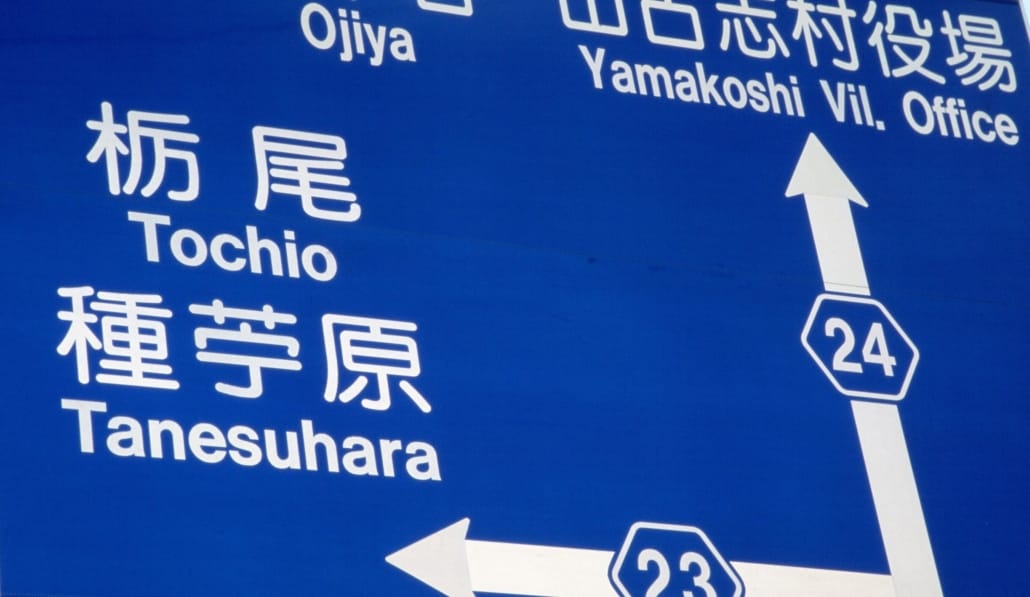
In this text we’ll do our best to elaborate, but consider this, each year in the eight week period starting round about the first week in October and ending the last week in November, more than a million of the very finest Koi in the world will be harvested from around 20,000 mud ponds, in a tiny fifty or so square mile region in Niigata Prefecture North West Japan, in the mountains surrounding the cities of Nagaoka and Ojiya. That’s Harvest time in Yamakoshi!
Both the place and the time have gently evolved over generations to become the epicentre of the worlds Koi industry. The unique terroir is a result of a combination of land, geology, climate, seasonal variation and history, culture and tradition and of course most of all, its the Koi and the people make this a very special place.
Yamakoshi isn’t a single place or village in itself. It’s essentially an unofficial collective of quiet farming village communities, but with a very special catalyst – Nishikigoi. Like all farming communities, life tends to be paced. Little is hurried or rushed, and life and times have a way of dictating their own timelines. Indeed for ten months of the year, Yamakoshi is no exception, but in a few weeks from the beginning of October each year, things change. A sense of urgency, focus and determination descends and pervades each and every aspect of the erstwhile sleepy villages, as the whole territory gears up for the forthcoming action!
At first, the pace accelerates gently, with nets and containers being checked and readied, then like some seamless un-choreographed military action, the whole atmosphere changes. First clues that the harvests are underway are telltale water trails following the increasing volume, and activity of the fleet of Koi trucks crisscrossing the mountains, with their newfound sense of purpose. Everything seems busier, the anticipation grows, and is palpable. Even the wildlife joins in with increased and somehow more purposeful sorties by sea eagles and majestic kites, scoping out their next potential meal courtesy of a Koi farmer, who might just not quite have his eye on all the juggling balls? While experience tells both parties – fat chance, expectation wins the day and the dance continues apace.
Greenhouse reception ponds are prepared. Air pumps, lines and ceramics checked and installed. Wellies and waders aired and readied,, and many a breeder can be seen simply looking skywards mulling the go, no-go decisions, that he knows better than anyone can make or break his entire year, the responsibility weighing heavy. Every breeder and his family has his own traditions, which determines the harvest preparation and execution processes, including exactly who does what and when. These roles are important and steeped in a combination of a tradition, religion and superstition. All are important, taken very seriously and any departure is deemed to bring misfortune, at best, and disaster at worst. This includes using the same pair of scruffy waders used by the breeder’s father before him, to his grandfathers favourite net being the first to breakwater in the harvest pond, and of course the harvest blessing with only the very best Sake, as using anything less would be disrespectful, and be sure to be accompanied by failure.
Before they’re released into the mud pond in early summer, each Koi is photographed either individually for older Koi, or for younger Koi as a group. This enables breeders not just to account for every single Koi, but to track, measure and assess, their individual progress. This is important because these Koi are the literal future of the breeder’s Koi farm. Success or failure, ignorance is never bliss for Koi breeders, they need as much information as possible, there’s no place for guesswork in Koi farming!
As new track entries not so randomly appear, as the spring and summers overgrowth is flattened to finally reveal access trails to secret ponds, tension and expectation builds. This is a big deal. But there really is nowhere to hide on revelation aka Harvest day! In the flick of a net hopes, dreams and aspirations, of a years work are either realised or dashed. Its the world cup final, super bowl, last put on the last hole of the last green, there are no possibly maybes, its hit or miss, hero or zero. To put this into context, consider for a moment the numbers for a small Yamakoshi breeder. With his five sets of parents, one produced nothing, ALL the fry from one set died, from the remaining three parent sets around 1.5m Koi initially survived, to endure subsequent culling processes. By October he’s sold a few its true, but essentially he’s now left with three mud ponds with his remaining 50 Tategoi in each, thats 1.5m to just 150! More so, the proceeds of the sale of those 150 Koi have to not only fund, ALL ongoing Koi activities, and feed his entire family through the long Niigata winter.
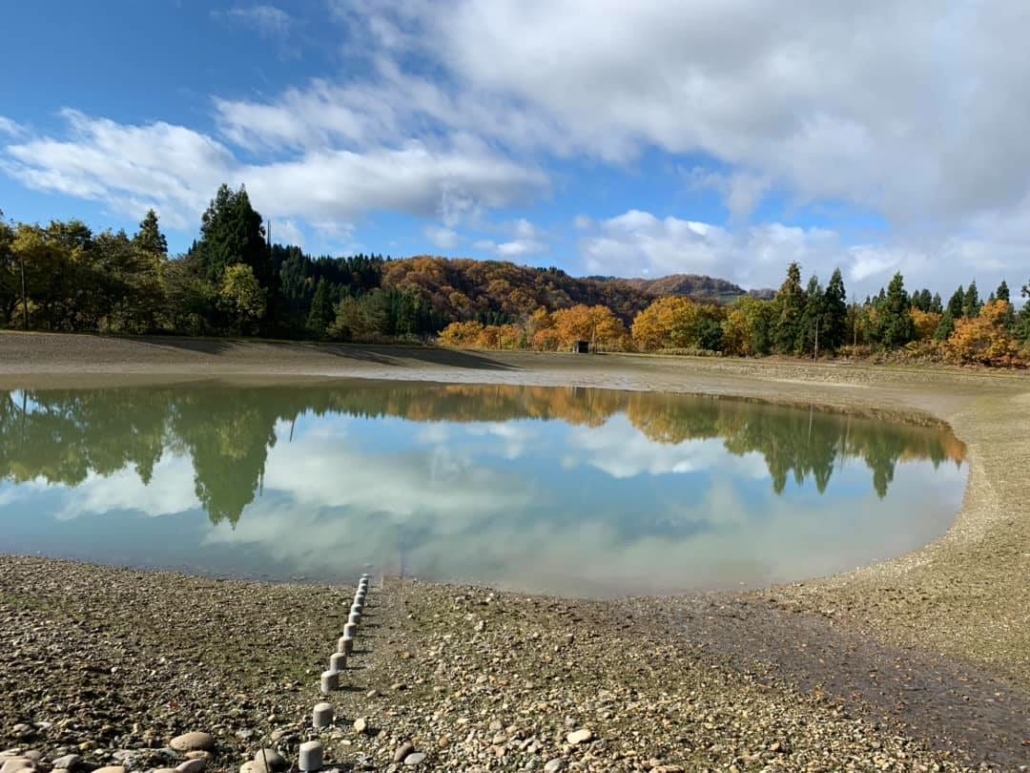 All mud ponds are drained in the days preceding the planned harvest to their lowest working levels. This is achieved using the drain pipes built into the mud ponds during their construction. This offers breeders sufficient visibility to safely catch all the Koi. Every breeder knows exactly whats in every single mud pond. Not just how many Koi are in every individual mud pond, but he also knows each Koi individually.
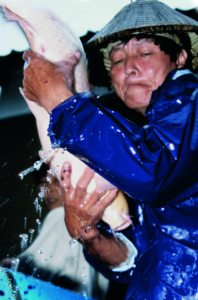
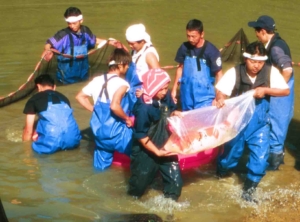
While most breeders favour the use of seine nets to corral Koi into waiting floating paddling pools, some breeders like Tsuyoshi Kawakami head of the famous Torazo Koi Farm, and Hisato Nogami, pictured below, prefers to use tradition hand netting techniques. This involves his wife, the real boss, splashing and disturbing the Koi so Tsuyoshi and his helpers, can individually catch the Koi. The process of harvesting a mud pond is called Ikeage, and some breeders allow visitor participation in their Ikeage, this is very much a privileged rather than a customer perk, and not all breeders allow it, but as more and more western visitors arrived in Niigata, in the last decade of the last century, so the practice grew, its the ultimate Koi experience for any Koi enthusiast!
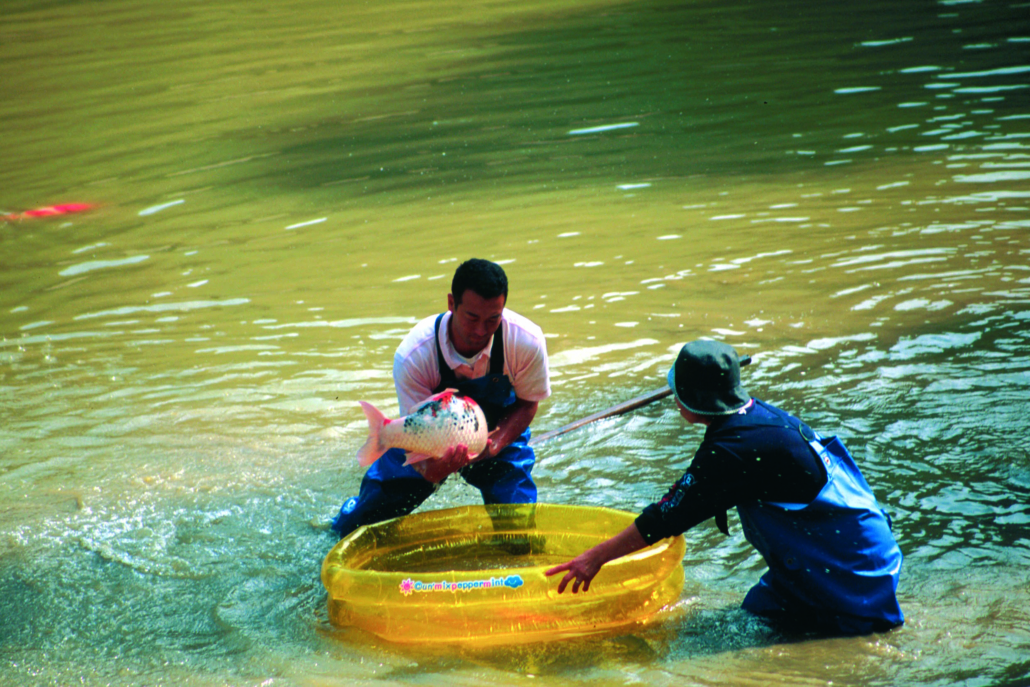
Yamakoshi breeder harvests really are justifiably the stuff of legend. From the early days of the 1970’s when virtually no western Koi visitors ventured forth, through the halcyon days of the 1980’s and 1990’s, when increasing numbers followed the path of early UK Koi pioneers, and revealed to us all the mystique and magic of Yamakoshi through tales, stories, articles and those fantastic Nik Read New Vision videos, that transformed this silent ancient territory, into an absolute hive of excited activity for a few short weeks.
This is a territory where reputation and fortunes were made and lost, but as all the visitors come and go, and the seasons rise and wain the breeders remain, like the terrain, constant. Life, like the seasons and the years turn, individuals change, and the natural order ebbs and flows, last years hero is this years runner up, or loser, nothing but the land remains unchanged, and in this part of the world, and even that’s not assured as the pacific ring of fire flexes its enduring and unstoppable power.
But still all that energy is challenged by this stoic enduring people. There is a strength here, an intangible resolve that bruised, occasionally battered, and once or twice in a generation even levelled, but its never extinguished. It seems almost self perpetuating, supported and emboldened by unselfish generations, without agenda, but with a commonality of unambiguous purpose.
We know few Koi visitors to Japan who not only endorse it to fellow travellers unequivocally, but that also find a small part of themselves forever mentally journeying back there from time to time, either consciously or sub consciously, such is the unique mystique of this magical territory. Of all the many wonderful places Japan has to offer, there are few that compare to Yamakoshi, and none that compare to Yamakoshi at harvest time. We recommend it unequivocally, and for the few that actually manage to retrace the steps of Koi enthusiasts the world over, who have journeyed thus, you will instantly get it!
Whatever you decide, do decide…and do go!
Truth be told it doesn’t really matter when you visit, as long as you do visit. Japan will change your perceptions, views, thoughts and aspirations, about everything Koi, forever and permanently. But for some, it also changes them “per se”. Unique is a much overused term, but Japan is truly unique. Her many and varied treasures are genuinely about much more than… Just Koi!