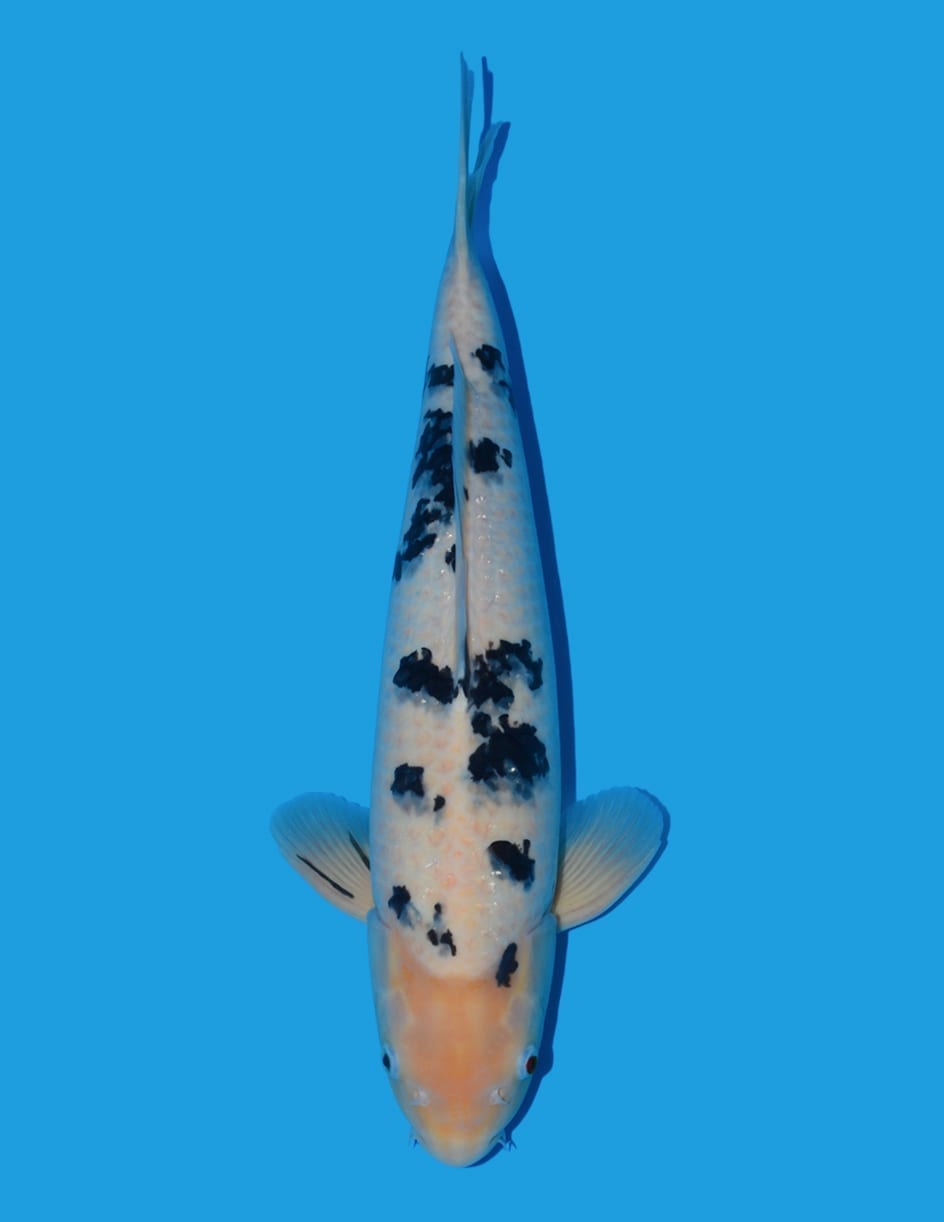
Aka Bekko
Essentially are red and black Koi. If there is any white visible on the Koi its an Aka Sanke, a Sanke variant and not a Bekko.
Ki Bekko
All the above is also the case for the yellow and black – black and yellow Ki Utsuri except in this case the incidence is even smaller. We’ll stand to be corrected but, as of Summer 2020, we know of only a few breeders endeavouring to produce Ki Utsuri specifically. Any and all that do occur are bi-products of mainstream Showa breeding.
Head
The head of all Bekko are extremely important. The strong balanced form should also have clarity and an unstained elegance that should enhance and frame the rest of the Koi.
In Shiro Bekko there are two other important head attributes that are desirable. As Koi grow so their skin develops and white head on Shiro Bekko is an attribute especially sought after. In young Koi the head is often a yellowish shade of white, that’s because its the Koi’s skull you are seeing. In great Shiro Bekko the skeleton of the skull is hidden by developing and thickening white skin. Blue eyes with or without eyelash pigment further enhance the effect and overall appearance of good examples.
Pectoral Fins
Pectoral fin attributes in Bekko are exacting and unforgiving, because Bekko are Sanke derivatives, pectoral fin sumi radiates in stripes from the base of the pectoral fins like Sanke, as opposed to appearing more solid as it does in Showa. Consistent lines/stripes of sumi are most desirous and spurious spotting, and staining is always noticeable and often detracts disproportionately. It’s not uncommon to see a fleck or block of the main body colour in one or both Pectoral fins. This isn’t desirable and would be demerited in a show, but in some examples can be a charming eccentric addition. In Shiro Bekko white pectoral fins and dorsal are especially sought after, and they’re also rare.
Sumi
Just like sumi in Sanke, Bekko sumi is required to be thick, dense and homogenous. This translates into a consistent, defined inky appearance. While all sumi has a tendency to appear and disappear, Bekko sumi is, at least of the face of it, like Sanke sumi, less unstable than Showa or Utsuri sumi. That doesn’t mean it doesn’t come and go, but rather the nature of it renders these vanishings and appearances less conspicuous. In some ways that makes the sumi that is present even more important to the overall impact of the Koi.
Finally, like all sumi, Bekko sumi is also sensitive to many factors from food to temperature and of course can be terminally affected by environmental factors like overstocking and poor and fluctuating water quality.
Bekko hunting advice?
Unless you have a particular personal proclivity towards them avoid Aka and Ki Bekko. The lack of specific bloodlines makes finding a good example even more challenging than most. In addition, if you do find them they’re likely to be disproportionately expensive. Shiro Bekko, on the other hand, are relatively prevalent and make a fantastic addition to any collection. While Tosai Shiro Bekko can be risky, the price often reflects this, so are often worth a go. By the time their Nisai they’re less unpredictable, and the price hasn’t yet escalated to the done deal level of an accomplished mature example where the risk is less, but the price often exponentially more. Whatever your expectation or desire, the reality is you need to be prepared to pay for accomplished examples, but our view is that charming good, rather than exceptional great for most collections, is absolutely fine!