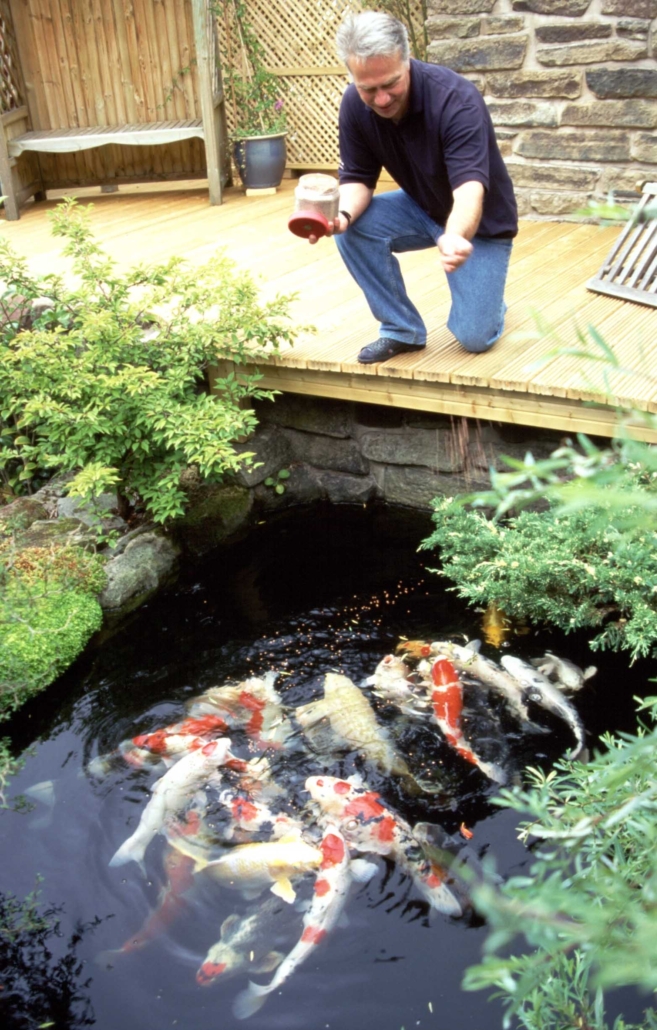
How to feed Koi
This might seem an almost irrelevant and obvious question because it’s simple – you open the pack and chuck it in! Of course, in essence, that’s true but this is also an area where smart Koi Keepers can sneak advantages and benefits for your Koi, but only if you pay attention to this much-underestimated aspect of Koi Keeping.
Of course, feeding our Koi is one of the absolute best bits of keeping Koi in the first place, but by adding a bit of science and experience, the simple mechanical process of feeding can be elevated, and benefits gained. Koi Ethology is the study of the behaviour of Koi. Individual Koi are just that. They all have individual traits and habits. These are technically called cognitive behavioural responses and before you all yawn and fall asleep, please bear with us for a minute. We’ve already learned that all Koi are unique, but it’s not just their external presentation that’s unique, but the way they behave and respond too. For example, Koi swim differently. Some are graceful, some dash around the pond appearing constantly startled. Koi feed differently too. While some gently surface and cruise along almost inhaling pellets, others hide away and dart to the surface grabbing one or two, then dart back to the depths. While some Koi happily take prawns, cockles, and bread treats from our hands, there’s more chance of getting struck by lightning than our shy best Sanke doing so, so why is this? Its because they’re all individuals and although their cognitive abilities are obviously almost zero, their responsiveness to various stimuli are relatively developed. For us the important aspect of this, by tuning into their individual traits we can get to know them individually. This isn’t just important because it enriches our own experience, but also because our Koi’s behaviour is an excellent early warning system, because often the first thing that happens when there’s a problem, is that our Koi’s behaviour changes, and most often of all – they go off their food.
It’s important not to misinterpret Koi behaviour also. Koi have off days. Koi have biorhythms. Some days are better than others, and this adds another layer of complication to interpreting their behaviour, but in time we can tune into these too and the combined benefits of truly getting to understand all your Koi, individually, is a massive benefit. Consider also that every individual Koi is a permanent, real-time, water quality test kit!
Of course, feeding is in the front line of this because it’s often the case that the very first things that happens when there’s a problem, is that Koi stop feeding. By contrast, the frenzy that often occurs when Koi spot the food might well be impressive, but that’s also potentially problematic because it might look impressive, Koi can and do damage themselves during a feeding frenzy.
Sinking & Floating Koi Food
Deploying a combination of floating and sinking proprietary Koi food not only helps minimise this frenzy, but it also offers those of your Koi that are less enthusiastic, timid feeders, the chance to actually get fed. As the season progresses sinking wheatgerm is especially useful for this.
Koi are Grazers
The genetic construction of Koi is such that they are “designed” to constantly consume small amounts of nutrition, rather than big volumes at a single sitting (or swimming). Although Koi do have stomachs, they are not designed to cope with large volumes perse. Their intestinal tracts are much more suited to processing regular smaller amounts. This is important because Koi food is useless unless its processed and absorbed by our Koi and their structure is such that they do this much better with regular small amounts, than they do with large irregular amounts.
There is some scientific evidence from the fish farming sector that indicates that feeding large irregular amounts is bad for them, while of course Koi are not Trout or Tilapia, and anyway it’s not conclusive and varies from species to species, it does bear out our Koi unambiguous experience that overall, small regular feeds deliver better development and health results.
Auto Feeders
Are excellent for facilitating our Koi’s propensity for grazing. Delivering regular small amounts of food makes them an excellent addition to any Koi system. The benefits don’t stop there either, an auto feeder feeding a prescribed amount of food at a set time everyday, is not only beneficial to the Koi, but it’s also massively beneficial to the filter system, mainly the beneficial bacteria (nitrifying bacteria) that process the water, as they get a steady and constant food source, instead of lets say two lager feeds at the beginning and end of the day, and for the filter, mechanically it’s less work as again not the same level of waste.
However, you need to be aware of their limitations. Like all mechanical devices, they are prone to malfunction and failure. When auto feeders do fail the result is often the dumping of their entire contents into the pond with obviously negative implications. Their other limitation is moisture. They simply don’t function properly if the food their dispensing or has dispensed, gets wet. In such circumstances, the delivery mechanisms are very susceptible to clogging and subsequent malfunction. For this reason, it’s always a good idea to protect them from the weather and splashing. Locate them out of, or suspend them well above, the splash zone often caused when Koi feed enthusiastically. We also recommend you don’t fill your auto feeders to capacity, then if something does go wrong the amount of food that gets dumped is limited.
It’s also important to consider them as a supplementary way to feed your Koi rather than the main one, simply because it’s not only fun to feed our Koi, but an important time to watch and observe them too.
When to feed Koi
This is actually a multidimensional issue. While the main influencing factor is pond water temperature, there are other important ones too, from pH, nitrite, oxygen, and light, to seasonality. It’s vital to get to know your system and your Koi, and to use this knowledge and experience to optimise the nutritional benefits of your feeding programme. Like us, Koi are creatures of habit, our experience has shown unequivocally that having a nutrition strategy – a feeding plan, not only delivers defining Koi development benefits, but also health benefits too!
We have developed a chart that helps you develop your own feeding plan. Obviously total amounts of food will vary depending on the number and size of your Koi, but it does provide a template guide. It’s also based on feeding wheat germ as a basic component year-round and reducing the wheatgerm as temperature increases, and gradually increasing the protein level of the food you give, as pond temperatures increase. We also recommend a short period of fasting where no food is given. This is less relevant if you only keep young Koi, but any Koi collection with mature and female Koi, benefit significantly from a period of no food. This is because at low temperatures (>15˚C) female Koi most of the energy derived from food goes to egg production and Koi produce enough eggs naturally, so any food is likely to result in excess egg production which is potentially problematic for female Koi in the short, medium and long term. The chart also offers our best advice on the best temperature to maintain for your Koi throughout the year, the specific recommended temperature range of 10˚C to 22˚C.