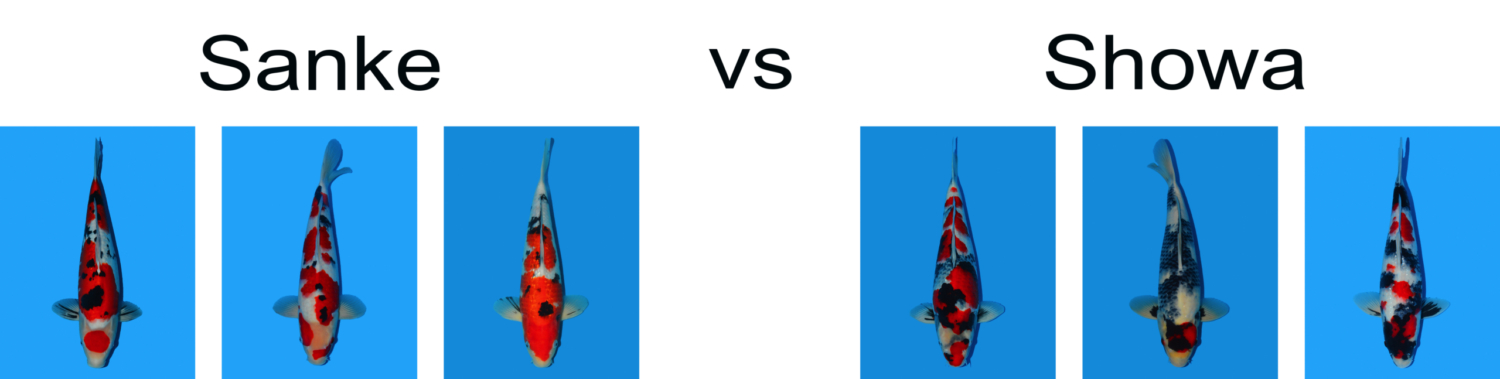
Sanke vs Showa
Experienced Koi students will probably be now assuming their best gloat expressions, and claim not to understand the problem! Clearly you’ve forgotten what it was like to be in the classroom when someone stuck their hand up and asked the question, you didn’t have the bottle to. Or been stood at your favourite dealers ogling the Koi, when a brave customer enquired… “how much for the Showa?” only to be quietly reminded, that the Showa was actually a Sanke?
Well, we were both those people, and understand the impact of that ground swallowing moment when we got it totally wrong, so this is for all the “us” out there, that this section is dedicated.
Although a myth and not the case, the simplest solution to this quandary, and in fact the next, is to think of Sanke as white Koi with red and black markings, and of Showa as black Koi with white and red patterns. The reason this makes it marginally less confusing, is that although there are many types and manifestations of white skin on Sanke and Showa, and infinite red (beni) variations, sumi is marginally less complicated and the solution to this quandary lies with the sumi. We’ve discussed the nature and presentation of sumi previously, and here we need to keep it really simple. Sumi in Sanke appears overlaid in segments whereas sumi in Showa appears to emerge from within, and then spread across the body of the Koi in blocks. Of course this is an outrageous over simplification, but it will help you start to see the fundamental differences.
Often the main confusions between Sanke and Showa occur between Sanke with lots of sumi, and Showa without much, so once again, when we get down to basics, it’s the sumi that’s the confusion culprit. While an overview assessment of the sumi often offers up a solution, in the cases where it doesn’t, there’s more help at hand.
Where Sanke have sumi stripes in their pectoral fins and tails called Tejima, and rarely, but not always, do not have sumi on their heads, by contrast Showa often have thick block sumi emerging from the base of their pectoral fins, called Motoguro, and most have some sumi pattern on their heads, with many having specific and imposing sumi patterns called Menware. So once again it’s the placement and type of the sumi, that gives the game away!
Note: The six photos below have been carefully selected to highlight the key differences we’ve discussed
Shiro Utsuri vs Shiro Bekko
As Shiro Utsuri are Showa with no beni, and Shiro Bekko Sanke with no beni, all the above applies, but the absence of beni often, but not always, make this job much less difficult. By sticking to the basics and not being intimidated by the task and remembering the key points we’ve discussed, the whole variety ID conundrum in general and the specific ones we address here, become much less problematic.
Kikokuryu & Beni Kikokuryu
Japanese Koi breeders are often heralded as pioneers and of course there’s some truth in that, as it’s mostly their work that results in new developments and variations, and some of that has produced some amazing results. It’s also true that they’re not shy at coming up with new and exotic names for variation on existing varieties, perhaps the best example in the last couple of decades is the Kikokuryu. For many years the metallic occasional especially striking Kumonryu would appear, often with the odd flash of beni and we happily called that a Beni Kumonryu. Some of these had luminescent beni, that extended into the black pattern offering up a metallic hue. Koi with larger areas of this effect became the source of much interesting discussion, and debate as to what they actually were, and at shows which category they should be placed in as historically it would be Kawarimono, but now these new metallic Koi needed a new name. Never slow to take up such a challenge the breeders went one better and invented a completely new name for these metallic Kumonryu with beni patterns. It’s also relevant that these Koi were always doitsu, so the Kikokuryu was born, and along with it, a whole new world of self inflicted confusion!
Here’s the timeline of the evolution:
Kumonryu = Kawarimono
Kumonryu with beni = Beni Kumonryu = Kawarimono
Metallic Kumonryu = Kikokuryu = Hikari Moyo
Kikokuryu with beni = Beni Kikokuryu = Hikari Moyo
Doitsu Hariwake vs Kikusui
Historically Kikusui was the ID reference given to orange/red variants of Doitsu Hariwake, with specific wavy lateral beni patterns. Over time and with changing market forces, and breeder inclinations, the wavy pattern reference has gotten somewhat lost in translation, and today the Kikusui tag is given to metallic doitsu Purachina Koi, with orange/red patterns.
The beni on Doitsu Hariwake is much lighter yellow based, and it’s the colour that differentiates them.
Doitsu Kujaku are repeat offenders in the variety confusion stakes, and Koi with light sumi occasionally intrude in this one also, but in this specific case its a bit less confusing, as Kikusui never have any beni or scale reticulation, so are true doitsu metallic, two not three coloured Koi.
Doitsu (no scales) vs Wagoi (fully scaled) of course introduces yet another degree of possible confusion, as if we needed another, and at the very least muddies the ID waters. As with other variety ID distractions; doitsu, gin rin, metallic, the important advice is to stick to the variety basics, and in this case it’s simply the colour of the beni;
Yellow = Hariwake , Orange/red = Kikusui.
Kujaku vs Hariwake
Many variety ID conflicts are often caused by either very light, or very dark examples of specific varieties blurring the ID lines, and this is a good example. Kujaku with light sumi, and/or scale reticulation, and more darkly scaled Hariwake can be very difficult to separate. Once again it’s the colour of the beni, in this case orange/red = Kujaku, Yellow = Hariwake. In addition the presence and degree of sumi that also comes to the rescue, as Hariwake are two coloured metallic Koi without sumi/scale reticulation, whereas Kujaku are three coloured Koi; it’s the sumi on the scale reticulations and the beni colour differentiating the two. Of course in doitsu Kujaku the fundamental lack of scales adds extra confusion, until we get back to basics and remember, that Hariwake are essentially Purachina with yellow (two colours – no sumi) beni, and Kujaku doitsu Matsuba with orange or red beni (three colours – with sumi).
Fortunately, they both go into Hikari Moyo, so at least in a show context the definitive difference is mute!
Doitsu Yamatonishiki and Doitsu Kujaku
Although the physical appearance of both these varieties of Koi can often appear similar, the secret to differentiating them is to remember that Yamatonishiki is essentially a Sanke, and not a Kujaku. Even in doitsu form Yamatonishiki is still a Sanke, albeit a metallic version, and in this case doitsu also. The confusion is introduced more so, because of the scaleless doitsu configuration, rather than variety specific similarities, by focussing on the Sanke rather than the doitsu, the characteristics become more apparent. The key is to practise and keep looking at as many of each as possible. Dealers are a great source of material and most professionals will be happy to discuss the differences, and add their experience to the mix.
Goshiki – the light and the dark
We saved the best for last, because the eternal confusion of separating Goshiki and Koromo, has tormented literally every generation of Koi keepers since the very start of the hobby, and it continues so to this day! Talking recently about this, with one of the UK’s most experienced Koi judges, he summed it up perfectly.
“Goshiki and Koromo, mmmh let me give you a football analogy… Put simply separating Goshiki from Koromo is a bit like the Koi Keeping offside rule. No one really understands it, not because its difficult, but because they can’t be bothered, and when you really get down to it, it’s not really all that confusing at all”
The reason it’s not really so confusing, is that among these fascinating varieties of Koi its good old sumi that’s at the source of most of the confusion, and furthermore when we really start to study Goshiki there are two fundamental types, more traditional Goshiki where sumi is present, and/or developed, and the more contemporary Goshiki where its not, and it’s the latter that’s responsible for most of the variety ID confusion issues.
Goshiki vs Koromo
Bearing our preamble in mind, and although the presentation of both these fascinating varieties can often look similar, there’s a really simple way to differentiate them. In Goshiki any sumi robing of the scales transgresses the entire Koi, and in particular is not restricted to the areas of the pattern with beni. By contrast in all variants of Koromo the scale robing is always restricted to the beni pattern. Of course this sounds fairly straight forward, but as always the actual practise can often be much less clear cut. The massive variation in the patterns of both varieties, especially where for example Koromo may have lots of sumi/robing or a Goshiki where the robing is very limited, can make differentiating them more difficult than it sounds.
And Finally…
Varieties of Nishikigoi really are one of the most fascinating and beguiling topics in Koi. There’s enough material to provide us a lifetime of learning, and even then there will be a guessagoi or truly unique Koi that pops up, and once again has us scratching our heads.
The concept behind this section of The Oaks Koi Farm information resource, is to tackle just a few of the more common varieties that get confused, but perhaps more important it’s to highlight the principles and real core difference, that usually offer a clue or two, to any Koi’s true variety ID.
The moving goalpost nature of the challenge, will always ensure there’s no such thing as a definitive guide , but we hope this has whetted your appetite to learn more, and at least provided you with the basic information to start to build up your own understanding. In final analysis when it comes to Koi in general, and Koi varieties in particular, understanding a little is always better than learning a lot!
Good luck with your journey!