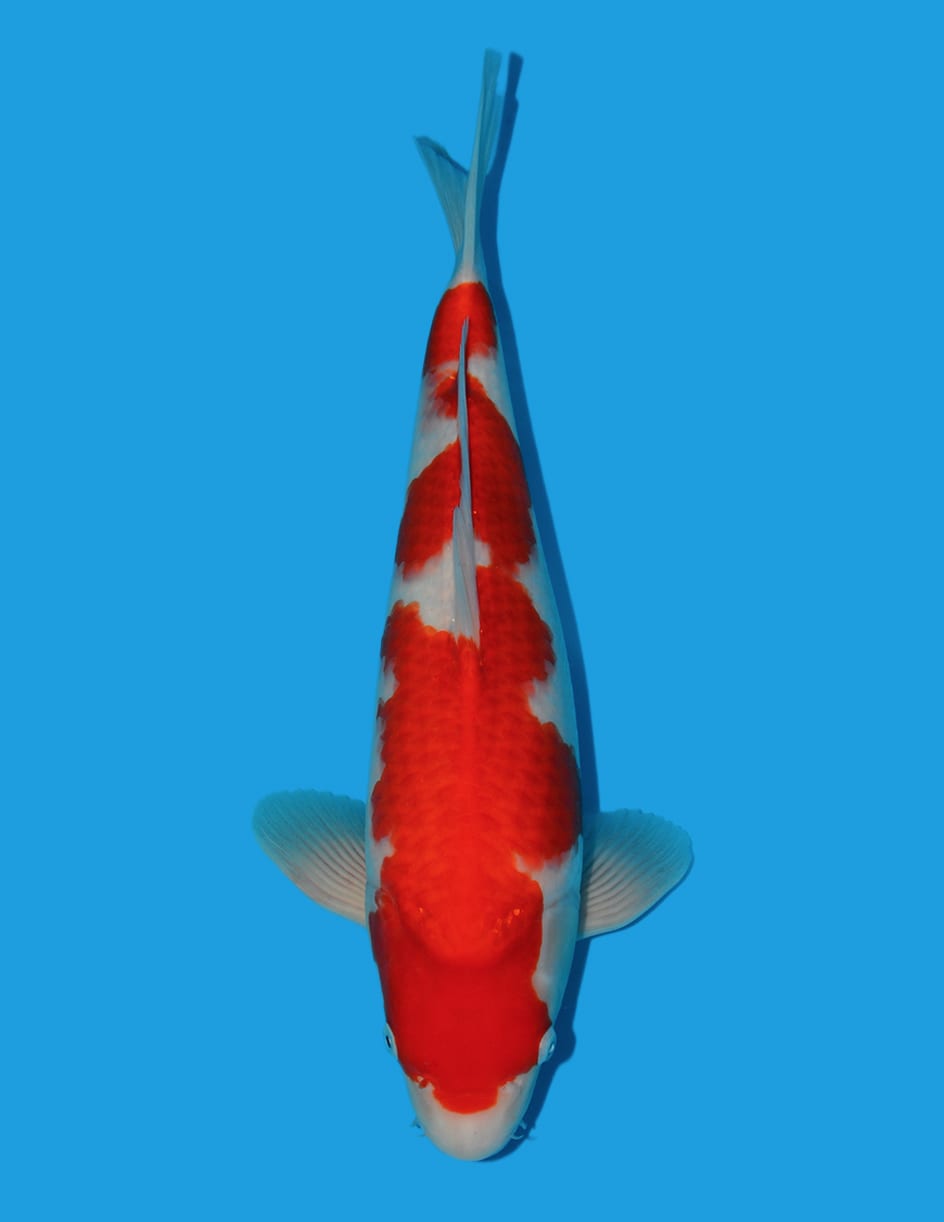
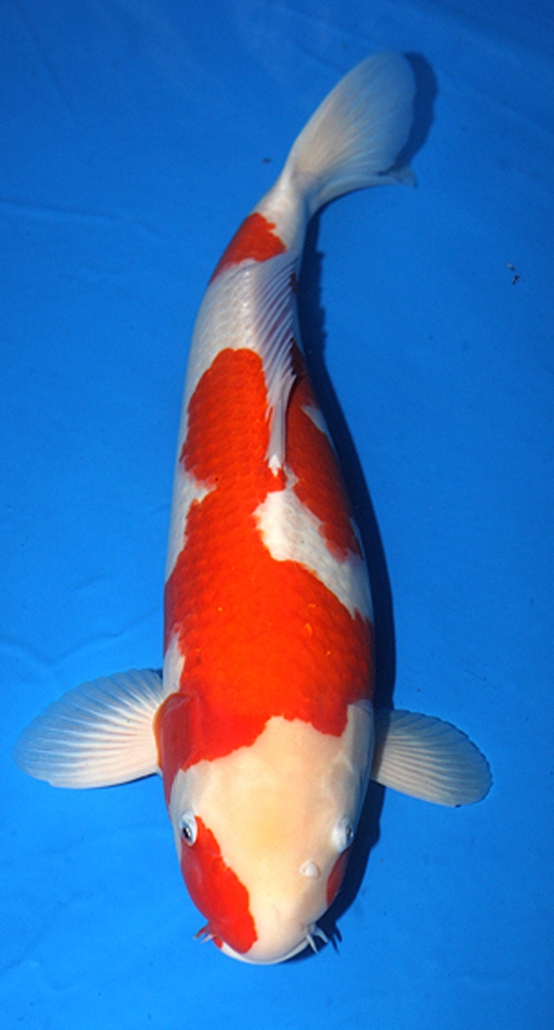
Show us a Kohaku expert and we’ll show you a delusional fibber. Like all those truly accomplished in their art, the biggest single attribute successful Koi breeders possess isn’t great skill, experience, or even the best Oyagoi on the planet… it’s humility. That’s because while their endeavours have taught them how to mechanically breed Koi, its taught them more about how not to. While they may have enjoyed some degree of success, any and all of those victories will have been partnered with total, abject defeat. While Koi breeding failure produces bad Koi, it also produces excellent humility.
It’s therefore fatuous for us to attempt to teach you about Kohaku, but what we can do is pass on our understanding about some of the mechanics of Kohaku, that are less difficult to communicate, and might just help you on your own journey. The topics we want to discuss are:
1/ Shiroji (base white)
2/ Beni types
3/ Pattern Configurations
4/ Structure
5/ Skin Quality
1/ Shiroji
White is white right? Well actually no its not? Most serious Kohaku aficionados will, sometimes reluctantly concede that although beni (red) is arguably the most important element of all Kohaku, it’s the Shiroji (base white skin) that defines the beni. You will need to work on that principle, but accepting its accuracy will help significantly with your process of understanding it. We originally combined shiroji and beni, because its the case that one defines the other, but then we thought that was a bit of a cop out, so we worked a bit harder and split them up.
If you consult any colour chart you’ll quickly conclude that there are many shades of white. That’s also the case with Koi. While in principle the whiter the better, of course it’s more complicated than that. Base skin colour is a function of skin quality, and skin quality is a qualitatively element rendering the definitive colour only part of the construct. This crazy assertion means, in practise, that the overall effect less accomplished quality, but glowing bright white skin offers, is less good than that offered by more accomplished quality, but not so glowing white skin.
In Kohaku colour is a function of quality, and this applies to both Shiroji and Beni!
The range of Shiroji in Kohaku is vast, and while we’re naturally drawn to bright glowing white-white, it’s important not to be seduced by this single dimension, and that we also pay attention to the quality. Good Shiroji also has depth. This defined by the thickness of the base white skin, and again this thickness is important, because if it doesn’t have this element, it can often appear pasty and translucent. It’s also a long term issue as well as a short term one, as basic physics determines that its much less likely for thin Shiroji to look better, as the Koi grows. As Koi age Shiroji changes, this is caused by a combination of natural ageing, and the stretching process. What might appear a technical point, as is often the case, just applied common sense?
Finally, Shiroji is one element, albeit a crucial element that determines the overall quality, or not of our Kohaku. While we aspire to become a master of Shiroji, we also need to master all the other contributory elements too, and no matter how good (or not) one might be, also teach ourselves not to be over influenced by any individual element, not matter how important, at the expense of the overall judgements we make.
2/ Beni
Beni, Hi and red all have the same meaning. The reference isn’t exclusive to Kohaku, and it’s presentation and variety applies across ten of the thirteen variety classes, from Asagi to Kujaku, and Sanke to Koromo, and literally everything in between!
There’s little that’s simple about beni. In fact it’s a lifetime study topic all of its own, and it’s genuinely the case that the more we learn – the more we are able to learn. Like studying Koi, the complexities of beni can be as complex or simple as you want to make it. In common with other aspects of Koi thats actually much of the appeal. While some are fascinated by study of varieties or breeding, others are seduced by individual elements of appreciation, and there’s no other more fascinating than beni, in general and Kohaku beni in particular.
In its simplest form of course its just shades of red right? However, the reality is that, that’s where simple begins and ends. The variations are literally endless. While individual bloodline and parent combinations deliver traits and specific presentation ranges; season, diet, water quality, climate, stress, temperature, individual genetic combinations, and even the time of day, influence the outcome, and ultimately the type and colour of the beni presented in prodigy. Thats part of why breeders genuinely struggle to maintain consistency. Just like wine and the unique terroir that produces it, so it is with Koi. They too have good bad and indifferent production years, and in the case of Koi…three million variations in between!
While Koi keepers, Koi Judges and even breeders have their own preferences, qualitative definition of beni is surprisingly less complex, and determined by three basic elements, each having nothing to do with the actual colour. The three elements are: Thickness, Definition and Elasticity.
Thickness: All colours of all Koi are defined by individual colour cells called phages. Some Koi have more than others and the best are Koi with not only more colour phages, but denser colour phages. These phages are living cells that develop with the Koi, and throughout its life. They are sensitive to a range of influencing factors from water quality to food, and are vitally important to the overall presentation of the Koi. They are also extremely sensitive and easily disrupted and damaged. Maintaining excellent water quality, feeding only high quality food, and not overstocking are all important. Its relevant here, to also emphasise the importance of correct feeding. Colour phages are especially affected by feeding. The overuse of colour food for example, can be especially problematic. Koi have primary and secondary colour phages, the overuse of colour food can overstimulate secondary colour phages, which then manifest as secondary beni, which is rarely if ever beneficial to the appearance of our Koi. This process is exacerbated by the fact that secondary beni phages are often random and clustered, so appear on the gills, tail, head and mouth of our Koi, and rarely contribute positively to overall appearance. Despite claims to the contrary they are also often permanent, and rendered difficult to remove by their location.
Definition: The definition of all Beni is determined by the two previously mentioned elements, plus an additional factor. Their extent is fixed by Sashi at the front edge, and Kiwa at the back, because the front edge is overlaid with other scales it will always be less crisp, but it also needs to be contained and not bleeding or obscured by overlying scales. By contrast the following or back edge, called Kiwa, needs to be distinct, and crisply defined.
Elasticity: Arguably the most important element Beni phage requires, is the ability to stretch. The best Beni, because of the combination of the three elements we have discussed here, have natural elasticity. As the Koi grows and ages, dense well defined colour phages are able to accommodate this growth process, and stretch. Because of the original qualities this stretching process doesn’t impact negatively on the surface appearance. By contrast, lack of elasticity is a major reason for loss of beni. While this can be exacerbated by environmental factors, the actual cause of beni loss is genetic. Most breeders understand this very well, and have long since culled Oyagoi, with a propensity for poor beni elasticity from their parent Koi stock, so if your Koi starts to loose its beni, the problem is more likely to be with you than the source!
Warning: All the above crucial elements can be disrupted by poor water quality, poor feeding, stress, and overcrowding. It also doesn’t take long to terminally interfere with these processes, and the potential of many a great Koi has been permanently terminated by bad Koi keeping. There are no easy options when it come to successful Koi Keeping!
3/ Pattern Configurations
One of the most fascinating elements of Kohaku, is the sheer diversity of pattern. From simple iban (single red pattern) to complex flowery patterns and literally everything in between, the snowflake essence of all Koi is personified in their patterns, and nowhere is it better manifested than with Kohaku.
Maruten vs Tancho
Tancho refers to a single red spot on the Koi head, but when there’s also subsequent beni pattern, the reference changes from Tancho to Maruten. This can be confusing, hence why we’ve included it. There are also specific elements that elevate (or not) Kohaku, which is important to know about, if for any reason, it will help you make better purchase decisions.
Head
The head and head region of a Kohaku is vital, as it sets the tone for the rest of the Koi. Balance is important and if there is beni present, it needs to be balanced and pleasing. Shape and proportionality is also important. The shape needs to be structurally correct, and its size in proportion with the rest of the Koi. It’s a common problem in Tosai and Nisai in particular, that heads are either slightly too big, or even more often too small, so pay attention to this detail.
Fins
While white finnage is most sought after in Kohaku, the very least they have to be is free from any beni incursion, or staining of any kind. The fins also have to be the same size and shape, avoid any shape anomalies especially on young Koi, as the anomaly is likely to exaggerate as it grows. Equally as with the head of our Kohaku, check the fins. In addition to checking for shape and size consistency, check they’re actually all present and correct!
Clear Dorsal
The importance of a clear unstained dorsal fin on Kohaku is hard to exaggerate. In addition, ideally the dorsal region should also be white not red. Further, wherever the delineating lines are, they should be clean and crisp.
Ojime
Just like the head of our Kohaku the back end is also crucial. The ojime region is the part of the Koi where the dorsal fin ends, and the tail joint begins. Balance in this region is important, both structurally and aesthetically. It’s also important with Kohaku that red pattern is present and balanced. Often we get distracted with Kohaku that are fantastic up to the dorsal fin, but compromised by the total lack of any beni beyond the dorsal area. This is always a problem, and always get worse as the Koi grows.
Mouth
While red on the lips of our Kohaku (kuchibeni) is often a charming extra, if it extends too much it is a demerit, but with Kohaku there’s a bigger potential issue. Mouth deformations in Koi are much more common than you’d think, so its vital that you pay attention to both the shape, construction, and size of your Kohaku’s mouth. Koi should also have two sets of two barbles each side, four in total – make sure they have!
Elements of Kohaku to Avoid?
It might seem twee to mention elements of Kohaku to avoid, but we’d be remiss if we didn’t mention the most important. These mainly apply to presentations that impact negatively, and elements unlikely to impact less so, as the Koi grows and develops. Menkaburi or hood, refers to a Koi’s head thats covered in colour, in this case red. Its also a case of where occasionally too much red isn’t a good thing. The reason being it renders the Koi less elegant.
While the final three elements we want to discuss are essentially Koi elements, and not specifically Kohaku elements, they do all have particular relevance especially if you are to select better examples and enjoy your Koi keeping more, and thats really what this information resource is really all about…
Proportionality: Koi with head or fins that are either too big or two small, or in any way out of proportion to the overall Koi, are to be avoided. This can range from any and all malformations, to crimped pectoral or dorsal fins, often caused by them being kept too densely stocked when very young ,to twisted heads, mouths, and tails that are too big or too small, or body line anomalies like pigeon chest.
4/ Structure
The structure of all Koi fundamentally defines their ultimate quality. This is of course true in Kohaku, so paying attention to the structure of your Kohaku is crucial. However, while structure is crucial, don’t get too hung up on shape, they are not one and the same. While structure is genetically fixed, the shape of Koi changes throughout it’s life.
The structure of a Koi also affects the way the Koi swims, and appears in the water. Poor structure often results in staccato (jerky swimming) while accomplished structure facilitates more elegant graceful movement through the water. You will soon see the difference, now you’re paying attention!
5/ Skin Quality
We left the most important till last because it matters little what shade of Beni or Shiroji your Koi has, if the quality of the skin is poor. Skin quality defines everything. It’s also one of the rare elements that are determined both by genetics and our keeping skills… Sand paper or silk, the choice really is yours!