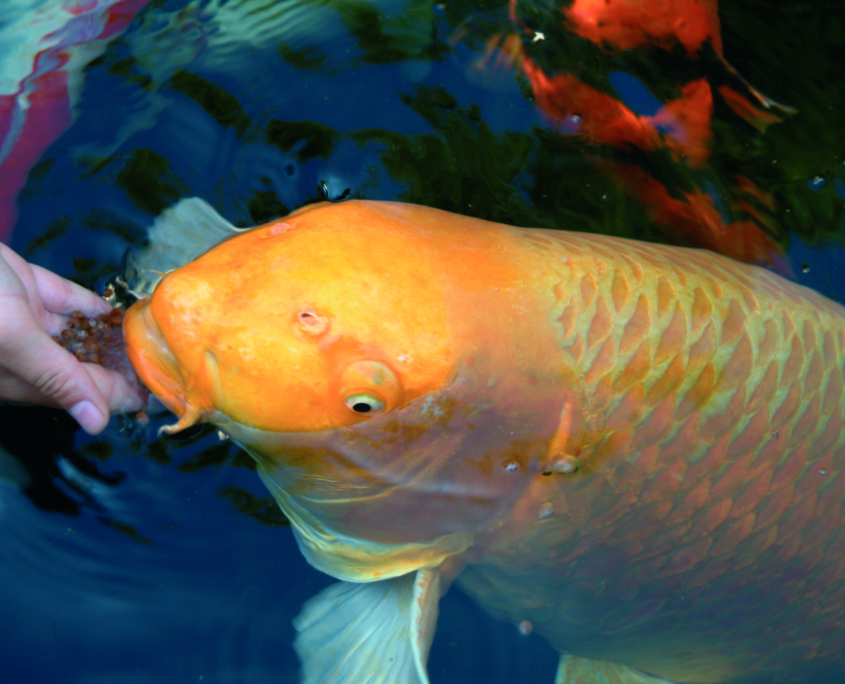
Yamabuki
While there are various sub-varieties included, the classification is dominated by the Ogon and Matsuba double acts: Yamabuki and Purachina Ogons and their respective Matsuba counterparts Kin Matsuba (yellow Koi with reticulated scales) and Gin Matsuba (while Koi with reticulated scales). This domination extends to the regard and respect they are given, and the presentation order is as-is. While most of the lesser varieties within this classification are largely ignored, and at best regarded for their novelty value, the opposite is the case for the highly regarded and revered Yamabuki and Purachina. Indeed their primary notary producers Izumiya and Choguro, are among the very highest echelons of breeder hierarchy by virtue of these two varieties.
Izumiya Yamabuki are indeed the stuff of legends, with the best of the best of them being sought after by collectors the world over. If you want a serious example you need to be prepared for two things: 1/ A long orderly Queue and 2/ To pay lots of ¥! …and that’s assuming there are any available in the first place!
Of course today there are many other breeders producing Yamabuki and their derivatives and some produce exceptional examples, but none have ever quite matched the finish, finesse and simple excellence of Izumiya Yamabuki. A combination of fantastic variety elements like lustre and fantastic clear heads, combine with Koi attribute excellence too, like incredible body structures, beautiful and elegant finnage, and graceful deportment, which all combine to deliver an amazing Ogon package, of the highest quality.
Although Yambauki don’t have stabilised bloodline, Izumiya is as close as it gets without so being, and although many many have tried to copy and emulate master Seinichi Mano, none have really cracked it, although some are these days, pretty close!
Purachina
Similarly Choguro remains the other Ogon master, in this case, the Purachina king! Despite a series of serious challenges in the last decade, Choguro remains the goto Purachina man! The sheer clarity and lustre of the white skin is matched by clear bright strong heads and luminescent fins, often characterised by strong gleaming flag like dorsal fins, and unmissable gleaming pectoral fins. While great examples can be incredibly impressive and imposing, they are equally unforgiving and easily compromised, and even spoiled by relatively minor issues that on lesser Koi would probably go unnoticed. Even scale reticulation can be a double-edged sword. In the very best examples, the integrity and balance offered can be breathtaking. The problem is it only takes an individual scale or three, to be out of sync and the whole effect becomes disproportionately compromised.
While this can be a big problem for the purists, its also a big opportunity for those seeking Purachina excellence, but without the budget to match. In addition, the difference really can be very small and although Choguro himself and staff will be able to spot the imperfection from three prefectures away, most informed hobbyists will need a minute or two, and usually a few pointers from the real experts to spot it. Certainly, most minor pattern aberrations that the breeders and expert contingent might find almost offensive are, in reality, almost invisible in a pond context. Given the often massive price differentials, and the fact that second rate Choguro Purachina are generally a country mile better than most other breeders, it’s not rocket science to figure out the next purchasing move?
Excellent Matsuba variants are much more widely available, simply because there are many breeders attempting to produce Yamabuki and Purachina, often from the master’s stables, and unceremoniously failing and ending up with Matsuba examples, and often very fine ones. This does go to prove it’s really not just about the female Oyagoi… but don’t tell everyone!