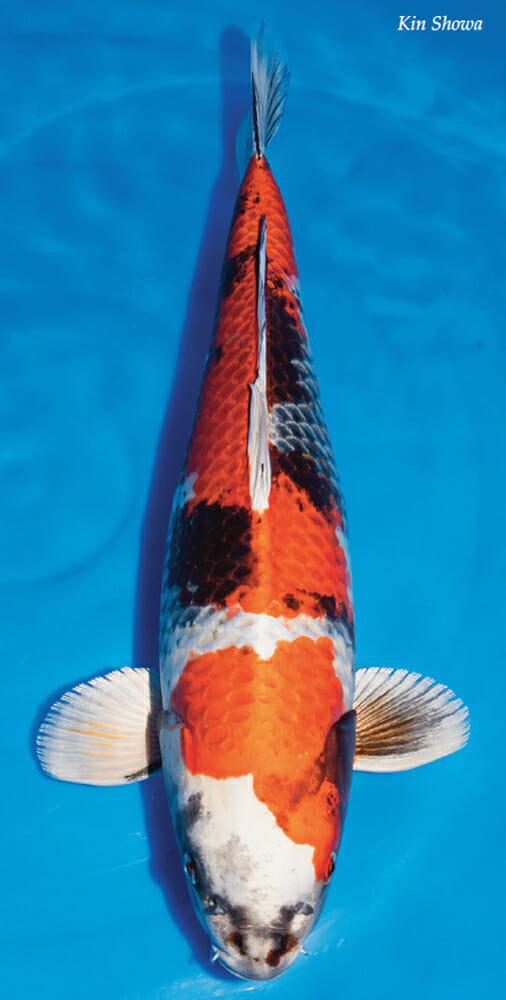
In addition to being usually relatively undersubscribed at Koi shows, these days its a relatively undersubscribed classification. Despite the diverse presentation of examples, notably metallic Showa, and the fact that a Kin Hi Utsuri once took the GC award at a BKKS national Show! The reality is that with the exception of a few individual metallic varieties like Kujaku and Kikusui, included in Hikarimoyo, metallic Koi are currently in the popularity doldrums. As with all market forces, supply is driven by demand, and when demand reduces so does the supply, and thats very much the case with Hikari Utsuri.
Although the odd spectacular Kin Showa occasionally still appears, Gin Shiro for example, very popular in the last part of the last century, are now rarities. The same applies to the once must have Kin Ki Utsuri, once a staple inclusion in most Koi collections, today very much the exception rather than the rule.
As a result, although we stand to be corrected, we know of no breeders specifically producing any of the varieties included in the class. As general market demand declined, so the ferocity of breeder culling increased, with the result that today only occasional exceptional (and expensive) examples appear. Generally the mid market pretty examples have almost disappeared, and are today surprisingly rare. That’s not to say they’re unavailable as large scale breeders like Hirasawa and Ogata, along with breeders specialising in the weird and wonderful like Otsuka, will usually have something for the Hikari Utsuri fanciers, tucked away in a sold pond or other!
Hikari Utsuri classification does however, provide an interesting show class for first time Koi show exhibitors to consider. Usually undersubscribed its not uncommon for awards to be noncompetitive, and given to the few participants that actually enter Koi in this class. Other often undersubscribed classes for first timers or inexperienced to target are: Bekko, Asagi/Shusui and even Kin Gin Rin, as apposed for example to the Go Sanke, Hikarimoyo, and the catchall Kawarimono, which are all often oversubscribed. We have a few more inside tricks of the trade for potential exhibitors in our Shows & Showing section, so if your thinking of showing make sure you check that out as it might just make a difference to the contents of your trophy cabinet!
Because this is primarily a metallic classification, its the degree of metallic lustre that individual Koi possess, that ultimately is the deciding factor. Of course we already learned that variety specific and Koi specific attributes are both requirements, but in specific varieties like all three metallic classes, Tancho, Koromo, Bekko, and Kin Gin Rin, its the quality of the variety specific attributes that ultimately define the Koi. Of course it follows that these elements also determine what wins at a show, and perhaps even more definitive – the price!
Devils in the detail
There are few aspects of Koi generally and Koi appreciation in particular, where detail isn’t important, but in specific classes like Hikari utsuri they’re often even more unforgiving, as the actual list of definitive requirements shrinks. The degree and quality of lustre defines the skin quality of all metallic Koi, but in Hikari utsuri there are some additional requirements. Specifically in addition to high quality lustre per se, they’re expected to have especially stand out lustre qualities on their heads, dorsal, tail, and importance in metallic Showa as the metallic qualities of the Koi exaggerate, whatever’s present – or not. Similarly clean heads are very important. While its fine and in fact beneficial for them to have both, motoguro and beni, its not okay for them to have spurious colouration, speckles, or bleeding, all of which are demerits in any Koi, but especially so in the metallic varieties.
Tails it is?
Another important detail to pay attention to are the tails of Hikari utsuri. They are required either to be sumi free, or to have sumi thats balanced with that present in the other fins. Again, because as you know the tails of all Koi are obvious and noticeable features, in metallic Koi they’re even more so, and as such the requirements are suitably increased.
All this detail is what Koi show Judges, and smart informed Koi hunters use to differentiate single exceptional Koi from a group. In the case of judges to award prizes and in the case of Koi hunters to make their purchasing selection. At some time in your Koi journey you will absolutely be either, or both of these, so starting your learning process early will inevitably also pay dividends at some stage, so well worth the effort!


