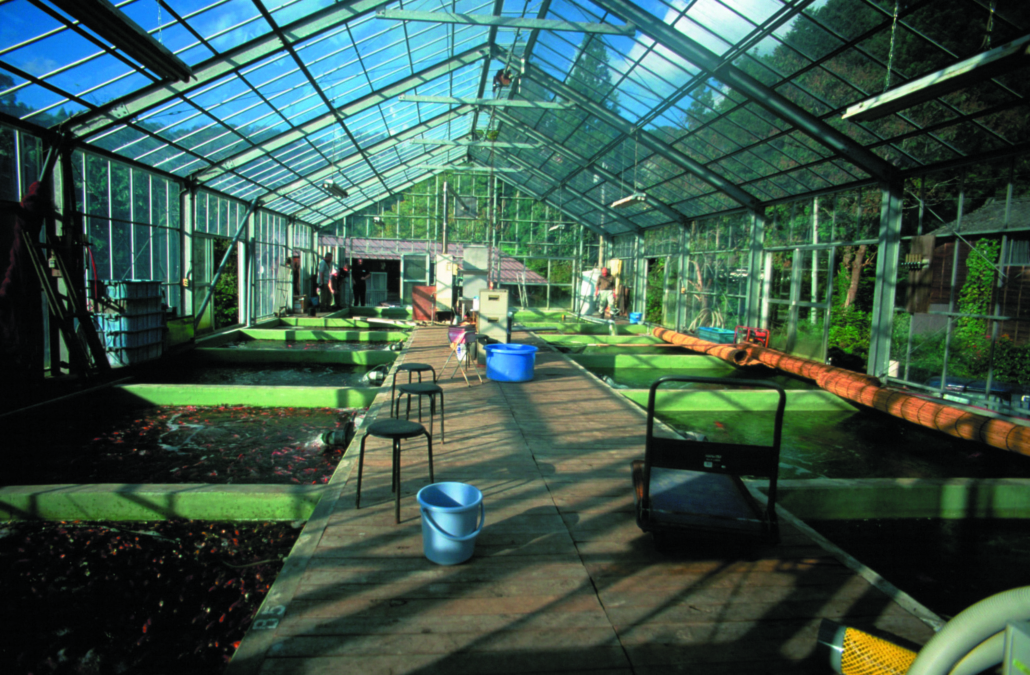
All breeders are seriously limited in the numbers of Koi they can keep and grow, so those that do now breed Koromo are incredibly selective in those they keep and grow. That’s the reason that today if we take just two breeder examples Yagenji and Oofuchi, while you are much less likely to find a whole selection of Koromo to choose from, you will still find the odd incredible example. Of course, their rarity is now reflected in their price!
Similarly, the breeders down south have been driven by the same market forces, and pursued the same broad demand-driven strategy. So while twenty years ago Hiroshima Sakai or Ogata, may have ponds full of a few hundred Ai Goromo, and a pond with a few hundred of Sumi Goromo, and their many and diverse variants, today you will be lucky to find a single pond with a hundred of the entire Koromo family mix, total.
When considering varieties of Koi it’s always really important to remember that even in 2020 there remain only two stabilised variety with specific varietal bloodlines; Kohaku and Sanke. Even Showa, which although in practical terms some breeders have been, their formal status remains unofficial. When we add to this the fact that all the Koi we know today were originally produced by accident and not specific intent, the position on the ground becomes a little clearer.
Fortunately, specific breeders, recognising the importance of preserving the genetics, maintain and promote specific variety Oyagoi, including Koromo parents, but it remains ad hoc and as such unpredictable. Interestingly the variety most confused with Koromo are Goshiki, and their ascendency has pretty much mirrored the decline of Koromo. So today its much less difficult to find a nice Goshiki, than it is to find a nice Koromo, a situation that two decades would have been completely reversed!
Although not strictly the case its easier if we think of Koromo as an essentially white Koi overlaid with various Koromo specific robed beni and sumi markings. In all Koromo the reticulation pattern is restricted to pattern areas and doesn’t impinge on the white, as it does with Goshiki. If you zoom in on the pattern of Koromo they’re all the same, what varies is the conformation and placement of the colour variations. If you can embrace that outrageous oversimplification, you will find differentiating the variants infinitely less difficult. Also don’t take it all to seriously, as the more you learn the more you will understand that its the ability to spot quality in Nishikigoi thats important, and not the much simpler ability to identify and differentiate specific varieties of Koi.
Ai Goromo is the most highly regarded of the Koromo variants and can appear especially beautiful. But don’t be fooled as the beauty of most is one dimensional, and often delivered only by virtue of exceptional white skin. Koi with great white skin often present disproportionately impressively, and Koromo in general and Ai Goromo, in particular, are no exception. Truly great Koromo, however, requires not just great white skin, but great Koromo attributes too, and for showing purposes, its the whole package that’s crucial. That of course provides Koi enthusiasts who just want a nice example of Koromo for their collection an opportunity, it’s the full package Koromo that command the prices, so lesser Koromo accomplished, but often very beautiful example are often available at more affordable prices… You pays your money and takes your chance!
Sumi Goromo are simply Ai goromo with more sumi incursion into the scale reticulation mix, than Ai Goromo where its beni that dominates, but while the combinations are many and varied, its the domination of the sumi that is the defining factor, because sumi in the ascension, the pattern conformations can and often are much more dominating often obscuring the white base skin, to a less or great degree. Its also worth considering that the sumi ascension often means that the Koi are prone to getting darker as the Koi, and their patterns develop. This is exacerbated in the UK where hard water dominates. In Japan the much softer water generally preserves white skin, and suppresses sumi. The softest water in Japan is found in mud ponds which is why when Koi are brought into concrete ponds the sumi often quickly comes up, transforming not just Sanke and Showa, but varieties like Kawarigoi, metallics, and of course Koromo, because sumi goromo and to a lesser extent budo goromo, are at the extreme of the Koromo sumi spectrum, the impact of them can also often be extreme.
Budo Goromo are so designated, because of the grouping of the sumi dominated Koromo features of their patterns. They’re alleged to resemble grapes, but although a convenient tag, one of us ever never quite see it? Nevertheless thats the reference and the differentiation within Koromo.
Many of these variations are quite subtle and almost impossible to articulate or represent in photo’s or even videos. By far the best way to pursue your interest and thirst for knowledge, is to drop in and talk to Paul and get him to pop a few into a bowl, then the whole challenge becomes infinitely less difficult.
While Koromo can be extremely beautiful and absolutely make a fantastic addition to any collection, their genetic instability and localised practical rareness, often means that a good un, is going to cost you. While thats okay in principle and absolutely okay for those afflicted by Korormo, the rest would be wise to read all the above carefully, before committing a big chunk of budget to any Koromo. As always our jobs just to give you the necessary information to make an informed choice, the actual choice is always yours!