For a simple element water is extremely complex. For most practical Koi Keepers understanding the basics is usually all they want to know because the detailed science of water chemistry is, lets face it, – boring. It’s often been observed that Koi Keeping is a blend of art and science, and, while most of us can understand why the more nerdy might want to get all anal about the techie stuff, the rest of us don’t really want to get into the science in any more detail than is necessary. Any of this sound like you?
Most Koi Keepers are familiar with water testing kits and the importance of monitoring key parameters. The list of important water tests for most might be: Ammonia, Nitrite, pH, followed by Nitrate and for a few Oxygen. Of course this is not unreasonable on the face of it, but as we often mention when it comes to Keeping Koi the devil really is in the detail, and in this regard we want to invite you to consider rewriting your order of importance. We’ll share our list later.
The problem is while the tests we do most frequently are important, there is one that’s not on most peoples list, that is in fact much more important than any, and that has a defining impact of the others as well. Carbonate hardness or carbonate alkalinity is the measure of the presence of carbonate and bicarbonate anions, its easier to understand if we apply a little artistic licence and call it Calcium Carbonate.
There’s also a very good reason we have put kH second only to oxygen as the most important elements for Koi Keepers, while it’s obvious if there’s no oxygen its usually far from obvious that there’s no Calcium Carbonate (CaCO3) and kH is essentially the measure of Calcium Carbonate in our systems. The reason its so important is two fold. Firstly, it’s an important mineral because its presence facilitates many vital functions and reactions necessary for our ponds to operate properly. Not least of which is nitrification…No CaCO3 = No Nitrification. Second, all our experience with trouble shooting pond problems over many years has revealed the lack of Calcium Carbonate represented by very low or no kH, to be consistently the actual cause of these problems and issues.
So all things considered its our view that Calcium Carbonate (CaCO3) is only second in order of importance to Oxygen (O2), as the most important element in any Koi system. This might be a worry to many who may have heard of it but never bothered to get to grips with it, and an even bigger worry to those who have never heard of it at all. Part of the reason for this is that there is a degree of applied basic science necessary to understand it, which simply turns some people off. So if you are up for it here goes…
Calcium Carbonate is an essential salt present in varying levels in all water. The specific indicator of it in our ponds is kH. The reason its so important to us is two fold. Firstly, CaCO3 stabilises pH preventing fluctuations and pH crashes both of which are bad news for our Koi. Second, its a crucial element necessary for the nitrifying bacteria in our filters to function and convert toxic ammonia to nitrite and then to relatively non toxic nitrate.
This nitrification cycle is fundamental to all Koi ponds, and the presence of Calcium Carbonate is fundamental to the operation of the nitrification cycle in all Koi ponds. Consider the analogy of trying to light a candle in a vacuum. So at the risk of repeating ourselves…
No Oxygen = No Candle light aka No Calcium Carbonate = No Filtration
Given this it’s clear to see why measuring and maintaining the Calcium Carbonate levels in our ponds is not just important, its crucial. The big problem however is that the level can and does vary. These days the Utility companies have thrown us an additional curve ball in that back in the day the source of our water was locally stable and didnt change much. Today thats not the case so its dangerous to assume that just because your kH has always been okay it will always be okay. The day to day nitrification process in filtration systems also uses up Calcium Carbonate and given that the primary source is tap water, if there is little or none in our source water its not going to be long before we have issues.
What kH level is ok? Carbonate hardness is usually measured in milligrams per litre (mg/l) or parts per million (PPM) which are the same. For our purposes either = 1 degree of hardness and it’s generally accepted that levels between 50 – 200 are an appropriate range for Koi.
However, being of the if it can go wrong it will school of Koi Keeping, our suggestion is that 100 is a sensible minimum. There are various test kits available some electronic and some reagent type but most measure and express the aforementioned degrees of hardness and each degree = 17.864 mg/l or ppm. To illustrate lets take a specific reagent test kit test:
5ml water sample – add one drop of kH reagent – sample turns blue – keep adding (and counting) additional single drops of reagent until sample turns from blue to yellow. Multiply the number of drops added by 17.864 to get your measurement.
For example if its 6 drops your reading is 6 x 17.864 = 107 mg/l, which is okay.
Important note: If your sample doesn’t turn blue when you add the first drop of reagent your Carbonate hardness level is below 17.864 and given our 100 guideline – thats bad news.
Watch Paul doing a kH – Test Buy kH Test Kit
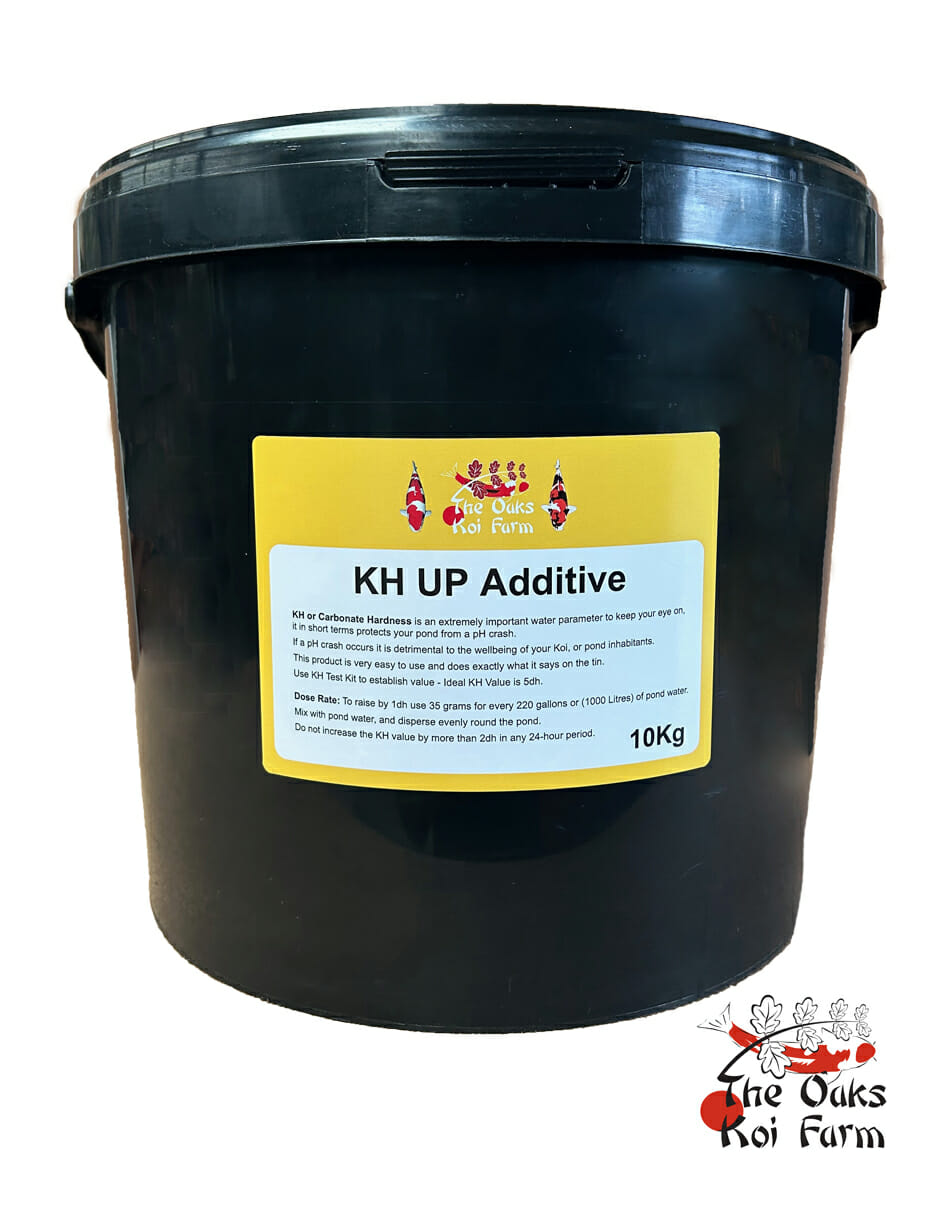
What do i do if my kH too low? While the problem isn’t simple, the solution is very simple. There are wide range of kH buffers on the market which will increase your Carbonate hardness levels quickly and effectively. As a quick fix some Koi Keepers use bicarbonate of soda/baking soda. While bicarb does increase carbonate hardness bicarb is essentially is carbonic acid and hydroxide neither of which would be within 100 miles of our… must use to improve the colours on my Koi list! The refined forms of Calcium Carbonate widely sold by Koi dealers as kH buffers don’t contain any potentially beni leaching elements. The former is more expensive and brings less/no risk of beni loss, the later is much cheaper but comes with risk, but… you are grown ups and perfectly able to make your own minds up about which is best for you.
The key issue is that you do indeed need to pay attention to the kH in your source water/pond and given that it can and does change, check it regularly and if it does go too low i.e. below 100mg/l or 6 drops in our reagent test kit – do something about it because if you don’t, you can
have the best filter system on the planet but without Calcium Carbonate your Aston Martin Vanquish is running on empty!
Almost finished….Calcium carbonate deficiency manifests itself in many and varied ways. While some are more obvious, like a pH crash caused by very low CaCO3 levels, many are not and some can be really subtle. As a general rule of thumb if there’s a problem with your Koi there’s usually a problem with your water, and if there’s a problem with your water kH is usually in the culprit mix somewhere, so it’s a good idea to put testing your kH close to the top of you water testing list.
Finally as promised, our list of the most important water quality parameters is simple and very short: kH & O2
and just because we can… pH, Nitrite and Ammonia.